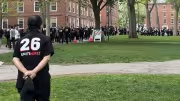
On November 11, during a solemn service in Memorial Church at which both President Drew Faust and General George W. Casey Jr., Chief of Staff of the U.S. Army, spoke, Harvard honored its military veterans (approximately 1,200 alumni have died in war); its students serving or training to serve in the armed forces (close to 150 veterans of Afghanistan and Iraq are now enrolled); and in particular the 16 alumni who earned the nation’s highest military award, the Medal of Honor, for actions “above and beyond the call of duty.” As part of the service, a plaque commemorating the medal’s recipients, installed near the altar, was unveiled, dedicated, and presented to the University by the Harvard Veterans Alumni Organization (HVAO; www.harvardveterans.org). At present, the plaque bears only 10 names, but news of its imminent dedication (see “Above and Beyond,” November-December 2009, page 69) prompted relatives of six more alumni recipients to contact HVAO, enabling ceremony organizers to distribute information about all 16 men at the service and to announce that the additional names will be added to the plaque by Veterans Day 2010.
The newly discovered recipients are: Charles E. Phelps, Law School 1852-53, and Horace Porter, Lawrence Scientific School 1854-55, LL.D. 1910, who rallied Union troops at the battles of Spotsylvania and Chickamauga, respectively; Henry S. Huidekoper, A.B. 1862, A.M. ’72, for his leadership at Gettysburg; Claud A. Jones, Graduate School of Applied Science 1912-13, for rescuing fellow crew members trapped in the “fire rooms” of their ship after the boilers exploded during a hurricane; Pierpont M. Hamilton ’20, A.M. ’46, for persuading an enemy garrison in North Africa to surrender during World War II; and Robert C. Murray, of the M.B.A. class of 1970, who threw himself on a grenade in Vietnam to save the lives of his men. More information about all 16 recipients appears at www.advocatesforrotc.org/harvard/honor.html; for more about the service, visit www.harvardmag.com/veterans-day-salute.