Since it appears we are in a period of seismic change, Harvard should take a hard look at its mission, its structure, and its financial underpinnings. Harvard’s greatest opportunity over the next quarter-century will be to bring together its separate areas of expertise to focus on a select group of “big” issues. It has an opportunity to use its resources and intellectual capital to analyze global issues broadly, across the whole University—and I believe it will need to do so, in order to maintain its leading position.
Harvard needs a new mission statement. It is one of the few educational institutions with the breadth of learning and inquiry and the financial resources needed to help solve the complex issues the world faces. The University should set for itself even higher aspirations. It has the resources to analyze, process, and recommend solutions to the increasingly multilateral, multicultural world of the twenty-first century. For instance, shouldn’t we be setting an agenda to be the leading center of knowledge about and scholarship on global health, food and nutrition, K-12 education in the United States, the biological and technological revolutions, and the global economic and political order?
To tackle such issues, Harvard will need to wrestle with its structure. The University is singularly blessed with broad excellence across many disciplines, but its 10 faculties have operated primarily as separate entities—each focused on its own agenda. There are many examples of cross-fertilization in the system because of personal relationships, intellectual curiosity, or competitive necessity, but nowhere near the extent necessary for new initiatives such as those cited. It will require a far more interactive, cross-functional mandate to integrate the competencies of the whole and bring the relevant expertise to bear.
This will probably require the allocation of more financial resources to the University’s center to ensure proper support for the broader mission. An expanded program of joint appointments and student cross-registration will also be essential.
Finally, the events of the past several years have shown that the financial model Harvard has been built on might not be reliable in the future. The assumption that alumni and alumnae support will continue at a level sufficient to permit fulfillment of Harvard’s mission, or that the government will continue to support its scientific efforts as in the past, is no longer secure. The new world will require both new funding sources and a fundamental review of University operations.
Global initiatives will open many new possibilities for funding. Harvard will also need to challenge and experiment with some time-honored postulates of higher education. To begin, we need to do a better job with fewer resources. We need to review the problem of educational productivity and the opportunities for technology to fundamentally change how we teach and learn. We need to consider how to better utilize our facilities year-round and, by doing so, how to handle more students effectively. We need to have a candid review of tenure and what the requirements of tenure need to be for Harvard to remain competitive.
The agenda is daunting, but Harvard should not be afraid to take advantage of its special place in the world, and its “brand name,” to embark on fundamentally new missions while making its structure flexible enough to deliver the best the University has to offer. Sounds like a good 25-year assignment.
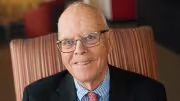
Franklin W. (Fritz) Hobbs ’69, M.B.A. ’72, a member of the Board of Overseers from 2000 to 2006, is currently chairman of Ally Financial Inc.