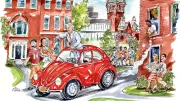
1917
With the country at war, Harvard’s Committee on Military Affairs advises alumni and undergraduates: “Rather than enlist as a private, try to qualify as an officer…or as a specialist.” Universities, notes the Bulletin, are best qualified to provide men with special training “above the ears.”
1927
The Faculty of Arts and Science implements a new academic schedule with two lecture-free “reading periods.” The reform is intended partly to free students “from a minute and continuous supervision of their studies” and to relieve teachers “from part of their excessive burden of teaching.”
1932
The College redivides some suites in the Houses to accommodate more men and bring down the price of rooms per capita, a measure designed to aid “men of moderate means.”
1952
Ralph Bunche, Ph.D. ’34, regretfully resigns his two-year-old appointment as professor of government. His U.N. duties as director of trusteeships and mediator between Arabs and Israelis have prevented him from holding even one class.
1967
The Undergraduate decries the stereotype of the Harvard radical as someone with an unkempt beard, wearing the same shirt five days in a row and carrying a protest sign. “The Harvard man may be bearded and unwashed (on weekdays),” the column asserts, “but he is probably in Lamont Library studying.”
1982
Anticipating federal and state cuts in student aid, Harvard announces plans to increase tuition costs by 15 percent. The increase of $1,560 will not only attempt to alleviate the cost of lost aid, but also increase the salary of junior faculty and pay for classroom renovations.
2002
The first Women’s Guide to Harvard is published, featuring everything from a directory of female faculty to information on gynecological exams. The book also includes accounts from Radcliffe alumnae, detailing styles, stereotypes, and even sexual harassment.