Dear Reader:
The text excerpted here was posted with permission of W.W. Norton, but that permission has since expired and the text has been taken down.
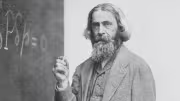
Read a Harvard Magazine profile of E.O. Wilson here.
Thank you for visiting.


The human urge to create art appears magnificently in the Paleolithic paintings from roughly 30,000 years ago at Chauvet Cave, in southern France. Here, the Panel of the Horses. | Photographs courtesy of the French Ministry of Culture and Communication, Regional Direction for Cultural Affairs, Rhône-Alpes region/Regional Department of Archaeology

A bison, shown in twisted perspective; the doubling of the hindquarters and the extra legs may depict the animal running, or two bison side by side. | Photographs courtesy of the French Ministry of Culture and Communication, Regional Direction for Cultural Affairs, Rhône-Alpes region/Regional Department of Archaeology

The Lion Panel, with bison (the lions’ likely prey), a young mammoth, and rhinoceros | Photographs courtesy of the French Ministry of Culture and Communication, Regional Direction for Cultural Affairs, Rhône-Alpes region/Regional Department of Archaeology

Red bear | Photographs by Jean Clottes/courtesy of the French Ministry of Culture and Communication, Regional Direction for Cultural Affairs, Rhône-Alpes region/Regional Department of Archaeology

One rhinoceros from a group of 17 | Photographs by Jean Clottes/courtesy of the French Ministry of Culture and Communication, Regional Direction for Cultural Affairs, Rhône-Alpes region/Regional Department of Archaeology
Dear Reader:
The text excerpted here was posted with permission of W.W. Norton, but that permission has since expired and the text has been taken down.
Read a Harvard Magazine profile of E.O. Wilson here.
Thank you for visiting.
Faculty leaders say layoffs will yield $20 million in annual savings.
The University is expanding industry ties and investing its own funds to support research, but neither will replace lost federal dollars.
Two tales of University greats—and an encounter with a Tiger

Harvard researchers investigate climate’s impact on cocoa crops, innovations in nasal vaccines, and links between pain and skull marrow.

Check back soon to take our survey!

Artists Enzo Camacho and Ami Lien turn a colonial symbol from Cambodia inside out.