A master palindromist (and stand-up comedian), Mark Saltveit ’83, of Portland, Oregon, moves backward as well as forward in life more than most of us. Constant readers will recognize him as the author of “No Smircog!,” a 1997 “interview” in this very space with Professor Osseforp about a Harvard-Yale football game, a piece full of “Eli bile.” Now we learn that he has won the first World Palindrome Championship.
Saltveit defeated two professors, two computer programmers, a cartoonist, and a book clerk to win the championship contest, hosted by Will Shortz, The New York Times crossword-puzzle editor. According to the championship’s official news release: “600 word nerds filled the ballroom at the Marriott Hotel at the Brooklyn Bridge and watched seven prominent palindromists deliver new reversible verses written on the spot. Audience members voted by deploying signs that said “WOW” on one side (for their favorite) and “HUH?” on the other.
The seven finalists had 75 minutes to construct palindromes fitting any one of three constraints: use an X and a Z in your palindrome; write about someone prominent in the news in the past 12 months; or about the competition itself.
John Connett, professor of biostatistics, almost won with a political tale: “Not Newt! Ron’s snort went on.” But Saltveit got four more votes from the audience for his elliptical tale of kinky shenanigans: “Devil Kay fixes trapeze part; sex if yak lived.”
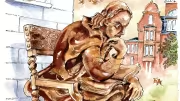
The trophy for the first-ever contest was made, Saltveit reports, by “artist and finalist Jon Agee out of cardboard. It is flat and was scored on the back and folded together, so that it looked like a regular trophy (i.e., the top half of what you see in the photograph).” At the triumphal moment, when a trumpet blared, Saltveit dropped the back half, and it unfolded into a symmetrical trophy.
“Sadly, at the reception after the awards,” says Saltveit, “I put the trophy against a wall, and it was stolen and is now undoubtedly displayed in a private collection next to stolen Van Goghs and Picassos. Or a janitor may have thrown it away, but I prefer the first scenario.”
***
Ripe for murder. When Cambridge architect Susan Cory, M.Arch. ’78, was studying at the Graduate School of Design, she found “a setting—insecurity and ego riding a particle accelerator of Design Obsession—just ripe for murder. I couldn’t understand,” she writes, “why there were no mysteries about architects and architecture students doing each other in.”
Cory fixed that with Conundrum (Cory Publishing, 2012), the first in a planned series featuring Cambridge architect Iris Reid as an amateur sleuth. Here she tries to catch a murderer at her twentieth GSD reunion. Good luck to her; all the incriminating evidence points to Iris herself.
***
Memorable master: It is said that in his earlier years as a teacher, Leon Kirchner, D.Mus. ’01, Rosen professor of music, who died in 2009, was “ferocity personified.” But cellist Yo-Yo Ma ’76, D.Mus. ’91, of Cambridge, was one of his students who later became a friend. In a memorial minute adopted by the Faculty of Arts and Sciences earlier this year, Ma recalled the vibrancy of Kirchner’s urgings: “‘No, it must be moooore beeeOOOtiful! Like this: ra pa-pa peEEEMm!!! paPEEEMm, paPEEEmm, paPEEMM!!’...Leon would exhort us to exceed our own capabilities by imagining, believing in, and creating a world that could transcend time and space, to go one on one with Beethoven, Schubert, Schoenberg, Bernstein. A charismatic raconteur, a man who enjoyed contradictions, who could be at once grandiose and vulnerable, endearing and prickly, Leon fired our young imaginations, sometimes leading us, other times deliberately becoming our ‘boulder in the road.’ Years later, we find he has left a permanent mark on us, having set our sights onto a universe both grand and wondrous, leaving us to find our way to reach for it.”