During the September 21 launch of The Harvard Campaign, five senior faculty members gathered at 1 p.m. in Memorial Church for a panel discussion on “The Future of Knowledge.” An interdisciplinary lot, weighted more toward the professional schools than the Faculty of Arts and Sciences—reflecting the University’s contemporary composition—they accordingly represented practice and application more than the arts and humanities or even the burgeoning social sciences. They were:

Photograph by Jon Chase/Harvard News Office
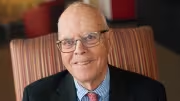
Jonathan L. Zittrain
Moderator
Jonathan L. Zittrain, professor of law and vice dean for library and information services at Harvard Law School; professor of computer science in the School of Engineering and Applied Sciences; member of the Harvard Kennedy School faculty; and faculty co-director of the Berkman Center for Internet and Society. His research interests include the control of digital property and content, electronic privacy, education technology (he moderated the “Online Learning” panel of the Harvard-MIT online learning summit last May, archived here), and Internet policy. The Faculty of Arts and Sciences highlighted Zittrain in its “Great Teachers” video series released last year. Harvard Magazine covered some of his early experiments with interactive teaching technologies a decade ago.
Photograph by Kris Snibbe/Harvard News Office
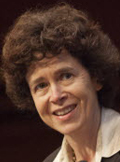
Rebecca M. Henderson
Panelists
Rebecca m. Henderson, McArthur University Professor, co-director of Harvard Business School’s business and environment initiative. In Harvard Magazine’s portrait, Henderson described her research focus on organizations’ inability to focus on large challenges in the future, and her optimism that despite legislative gridlock, progress can be made in addressing climate change through “the power of the private sector.” Henderson said, “We need clean energy. We need abundant clean water. We need safe and effective waste disposal.…Business can do that. That’s what business does.” At a “Harvard Thinks Green” event, she referred to a bubble diagram showing the overlap of sustainability and profitability and termed their intersection “a matter of painfully advancing a bloody frontier.” It is an area, she told the student audience, “ripe for the taking.”

Photograph by Stephanie Mitchell/Harvard News Office
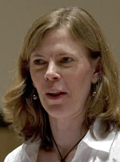
Hopi Hoekstra
Hopi Hoekstra, professor of organismic and evolutionary biology and of molecular and cellular biology, and Agassiz professor of zoology in the Museum of Comparative Zoology. Hoekstra was named a Howard Hughes Medical Institute investigator this past spring. Her pathbreaking work on the genetic instructions controlling observable animal behaviors was widely covered earlier this year; “Digging Deep in the DNA” is a New York Times Science Times profile of her research on the burrowing behavior of deer mice (accompanied by a Times video interview).
Photograph by Justin Ide/Harvard News Office
Alison Simmons
Alison Simmons, Wolcott professor of philosophy. Simmons, a scholar of early modern philosophy, natural philosophy, and theories of mind, has been named a Harvard College Professor, the Faculty of Arts and Sciences’ highest recognition for excellence in undergraduate teaching. With Bass professor of English Louis Menand, she co-chaired the task force on general education during 2006-2007, when the faculty undertook its protracted redesign of the Core curriculum and its replacement with the current General Education curriculum for undergraduates’ studies outside their concentrations. Since 2011, Simmons has been a member of the standing committee on undergraduate admissions and financial aid.

Photograph by Channing Johnson/Harvard Medical School
Peter Sorger
Peter Sorger, Krayer professor of systems pharmacology and head of the program in therapeutic science at Harvard Medical School. Sorger’s work—bridging systems biology and computational biology to pioneer new ways to develop effective drugs—draws on the multidisciplinary expertise of researchers across Harvard, the affiliated medical schools, and other Boston-area universities. The initiative was announced in 2011, and the current program, just launched, is covered in depth in Harvard Magazine’s report on “Systematic Drug Discovery.”