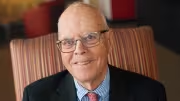
Dean Michael D. Smith invited Harvard Magazine to his University Hall office to discuss objectives for the Faculty of Arts and Sciences’ (FAS) $2.5-billion campaign, as outlined for colleagues in his annual report, released October 4, and detailed for supporters at month’s end. He distinguished two groups of priorities: “What do we care about most?” (those core commitments that “strengthen the current, ongoing activities…critical to our mission of research and teaching here”) and where “we need to invest” (“new things that the future requires us to look at”).
Among the former, Smith emphasized:
Undergraduate financial aid. The past decade’s increases in aid, and the College’s commitment to sustain them as family need rose during the recession (and the faculty’s long-term assets fell from $16.6 billion to $11.6 billion during fiscal year 2009), “have had nothing but upside,” he said, referring to the student beneficiaries. The aid budget was never “put on the table during the financial crisis,” he noted. But he worries about sustaining that situation “at the scale we have today”: only about half of this year’s aid budget of $182 million is supported by endowed funds. Nearly a quarter of FAS’s campaign goal, therefore, will focus on securing this core value, lest a future dean confront a crisis in assuring access to the College.
House renewal and the student experience. “Our commitment to residential education is as strong as it has ever been,” Smith said; one-fifth of the campaign goal is focused on students’ “learning across our campus,” not just in classrooms. Most of those funds are for the multiyear, $1-billion-plus House renovation and updating now under way (see page 46); Smith said much had already been learned about design, procurement, and the phasing of construction. The program has evolved, too: student requests for social spaces have been realized, for example, in Quincy House, in Stone Hall’s reclaimed lower level, along with music- and art-making rooms and a high-tech classroom where students can experiment with learning technologies.
According to the fiscal 2013 report by Leslie Kirwan, dean for administration and finance, FAS had spent $51 million on House renewal (planning, construction, and student swing space) through last June 30; the Corporation had approved financing plans for $209 million of construction; and donors had pledged $140 million in support. The full project will require use of endowment funds, reserves, debt financing, other cash—and philanthropy. “This…is going to be successful,” Smith declared, “because of the support of our alumni.”
Faculty and the scholarly enterprise. Another 20 percent of the campaign will be dedicated to this category, in three ways. First is securing endowed chairs (two-thirds of FAS’s tenured positions are endowed today) because, Smith said, professors are “worthy” of a career step beyond achieving tenure. (Endowments also relieve pressure on unrestricted funds. There will be “a little bit” of faculty growth as well, he said—but nothing like the 20-plus percent expansion during the last decade.) Second is supporting graduate-student fellowships—“the obvious way we grow that [scholarly] pipeline into the future,” as Smith put it: all the more pressing as cuts in federal-research funding—an “imminent threat”—restrict the prevailing support for science graduate students. The third is underwriting new research. For example, he cited the Institute for Quantitative Social Science, which has pioneered techniques enabling many faculty members to work with large data sets and pursue new inquiries, “an area that is exploding.” Securing endowed funding for the institute thus “ramifies throughout FAS’s scholarly mission.” (The annual report also cites brain science, energy and the environment, digital humanities, the arts, and understanding the origins of human behavior.)
The new emphases in FAS’s campaign plan include:
Leading in learning. “This is a period of transformation…in higher education,” Smith said: basic understanding of cognition has advanced, and effective technology has, finally, come to the classroom. He conveyed strong support for professors’ experiments with the HarvardX platform, “flipped” formats (students view lectures before class, and then work together and with faculty on problems in class), and hands-on design in engineering courses, on a campus long focused on lectures. Endowment funds will be sought to update the Bok Center into a locus for helping professors understand and apply “new things that improve student learning” in demonstrable ways. Other funding will underwrite course development, reconfigured classrooms, and training—“to support not just individual faculty in their desire to improve teaching,” Smith said, but “institutional change…so faculty and students can spend more time together in useful learning exercises” and “Harvard can show true leadership in higher education.”
The School of Engineering and Applied Sciences (SEAS). Beyond SEAS’s new Allston facility (a University campaign priority), Smith said, “We’ve always wanted to grow the school.” Nearly one-fifth of FAS’s goal focuses on scaling up the SEAS faculty significantly, securing research funds, and paying for graduate-student fellowships. (SEAS with a few dozen more faculty members would still be smaller than its Princeton or Caltech peers.) SEAS, he said, is “tightly tied to a liberal-arts education” in a university with unequaled professional schools and has already been notably successful in providing rigorous engineering concentrations; educating undergraduates generally; and building interdisciplinary collaborations “so we can tackle problems that have societal impact” involving law, regulation, medicine, and other fields. Smith said SEAS is poised for growth in computer science and applied math, both widely useful, and in bioengineering and environmental engineering, complementing other University expertise.
Decanal discretionary funds. Finally, unrestricted annual giving should total perhaps one-tenth of FAS’s goal, providing “the flexible funds that enable us to adapt” in a “changed” world, Smith said—citing the past half-decade of financial shocks, shifts in public policy, and fast-emerging opportunities in research and information technology.
As structured, he concluded, FAS’s campaign has been shaped both by “looking where our pressure points are today” and by “looking at where we want to invest so this institution can continue to be excellent” in the future.