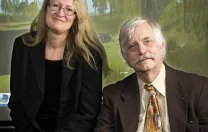
With schools more eager to welcome coding in the classroom, some advocates now push to make it a public-education priority. In her 2014 book Connected Code: Why Children Need to Learn Programming, Yasmin Kafai, Ed.D. ’93, of the University of Pennsylvania, urges schools add on to the traditional “3 Rs” of reading, writing, and arithmetic: the aRts and pRogramming. That the public perceives computers as both essential, and essentially opaque, is a form of illiteracy. Jane Margolis, Ed.D. ’90, senior researcher at UCLA’s Graduate School of Education and Information Studies, argues that this “learned helplessness” has larger implications for equality.
Margolis’s book Stuck in the Shallow End continues to be one of the few lengthy examinations of how an early section of the pipeline—public K-12 education—creates racial disparities in the field of computer science. Skeptics have dismissed the “coding for all” movement as a faddish boutique reform, myopically market-driven even as it claims to advance children’s problem-solving skills. But as technological innovations drive virtually every industry and shape social spaces online, advocates like Margolis view computational participation as central to the health of democracy. “Computer science can help interrupt the cycle of inequality that has determined who has access to this type of high-status knowledge in our schools,” Margolis and Kafai wrote in The Washington Post last October. “Students who have this knowledge have a jump-start in access to these careers, and they have insight into the nature of innovation that is changing how we communicate, learn, recreate, and conduct democracy.”
Despite the free programming resources available online for learners who know where to look, cultural barriers remain. Perceptions abetted by the hagiography of figures like Mark Zuckerberg ’06 and Bill Gates ’77, LL.D. ’07, inhibit wider participation: that the path to prowess swerves away from institutions like school, and that some individuals naturally gravitate to computer science because they are innately talented and freakishly autodidactic. In reality, the typical boy genius has a great deal of what Margolis calls “preparatory privilege”—if not tech-savvy parents and summer-camp enrichment, then usually a peer group logging on together after school.
Noel Kuriakos, a member of the online educators’ community ScratchEd, is a math and science teaching fellow at the tuition-free Mother Caroline Academy, a majority black and Latina girls’ school in Boston. His experience in a community where many households still don’t have Internet access has taught him that extracurricular outlets won’t suffice: “This is where schools can play a huge, huge role, and make a big difference—in saying, ‘Well, maybe not in your home, and maybe not in your social circle, but in school you can have access. You can do this.’”
Meanwhile, atop the structural issues that, in less affluent districts, impede learning in all subjects—underfunding, overcrowding, teacher attrition—computer-science education suffers from a special neglect affecting public schools across income ranges. Historically, it has been lumped in with home-economics class—“which, as you can imagine, makes it an attractive proposition to many computer scientists,” Kafai observes wryly. Most states lack curricular standards or a teacher-certification pathway in the subject. As a result, Margolis says, schools end up “tech-rich, but curriculum-poor.”
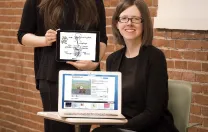
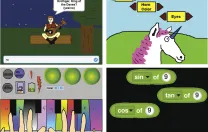
Margolis has helped write a high-school curriculum, “Exploring Computer Science” (ECS), that intends to expose students to a broad range of topics, including HTML website design, data analysis, robotics, and programming through Scratch. This will be paired with a professional-development course for teachers, who will learn inquiry-based pedagogy along with the content itself. ECS has received the backing of Code.org (the nonprofit behind the nationwide awareness event, Hour of Code), and has been adopted by districts in Los Angeles, Spokane, Chicago, and New York City, among others.
Now, Kafai is collaborating with Margolis to create an electronic textiles unit for ECS. By bringing together the crafts of circuitry design and sewing, they aim to appeal to girls by casting code as malleable, and engineering as an aesthetic pursuit. Because curriculum design in computer science remains largely uncharted territory, Kafai believes that researchers should keep the options open. “For computation, you need different materials and activities—it can’t all be robotics, it can’t all be game design. We need a whole array, to tease out what activities are good for which concepts, and which age levels. Because honestly, we don’t really have anything right now.”
Assistant professor of education Karen Brennan proposes that integrating computational thinking into classes could follow the language arts model, in which a class is devoted to the craft of manipulating words, but text, of course, is used in the service of other subject areas as well. With code too, “there’s specialization, but there’s also a role for it in everything you’re trying to do,” she explains. Though Brennan cautions that “Scratch doesn’t solve every problem,” she also adds, “If you start with the learning, you will not be led astray.”