Headlines from Harvard history

From the pages of the Harvard Alumni Bulletin and Harvard Magazine

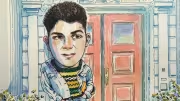
Babar receives an honorary degree from Harvard

Illustration by Mark Steele
With fond admiration to Jean and Laurent de Brunhoff

1916

William Stanislaus Murphy, Class of 1885, leaves all his money to establish scholarships at the College for young men with his last name.

1926

The first movie theater in Cambridge is about to open across the street from the Yard.

Harvard Crimson staffers journey to New Haven to leave copies of an issue containing an article fiercely opposed to compulsory chapel at Yale on the doorsteps of Yale Daily News recipients. Yale’s president states that “any contribution from Harvard would not in any way influence the committee in charge of the matter.”

1941

Reginald H. Phelps ’30, assistant dean in charge of records, reports that, between 1920 and 1940, the number of undergraduates making the dean’s list has risen from 19.8 to 30.7 percent, while the list of those whose connection with the University was “severed” has shrunk from 7.4 to 4.4 percent. Both 1940 figures set new records.

1956

A letter from Venezuela to the president’s office brings a reminder of the Thayer Transmittendum, a small award, started in 1848, dedicated to purchasing winter coats for deserving freshmen of little means. Of the seven recipients in the award’s 118 years, the most recent, Gilbert Slocum ’49, has sent the original parchment of the Thayer Transmittendum, plus $75 (to cover inflation since his own receipt of $50), back to the College to pay for the coat of the next recipient.

1966

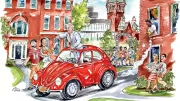
The Bulletin salutes the publication of Babar Comes to America, in which the famous elephant visits Harvard, receives an honorary doctorate of letters, and hangs out at the Lampoon.

1981

“To enhance the quality of our common life,” a student-faculty committee unanimously recommends establishing a foundation to improve relations among racial and ethnic groups on campus.
Related topics

You might also like

How the American Revolution Freed a Future Abolitionist

Darby Vassall, an enslaved child freed after the Battle of Bunker Hill, dedicated his life to fighting for liberty.

The Costly Choice Native Americans Faced

How the Revolution reshaped indigenous New England

When the Revolution Hit Cambridge, Harvard Moved to Concord

College students broke hearts and windows during their year in exile.

Most popular

250 Years Ago, Harvard Was Home to a Revolution

A look at the sights, sounds, and characters that put the University on the frontlines of history

Martin Nowak Placed on Leave a Second Time

Further links to Jeffrey Epstein surface in newly released files.

A New ‘Black Swan’ Musical Cranks Up the Tension

The creative team of the A.R.T.’s new show dish on adapting Darren Aronofsky’s thriller classic from screen to stage.

Explore More From Current Issue

Woman in historical dress standing in front of green foliage, smiling brightly.

This Harvard Graduate Brings Women of the Revolution to Life

Historical reenactor Lauren Shear reveals tricks of the trade for playing Tory loyalists, Revolutionary poets, and more.

Brick archway with a sandy base, surrounded by wooden planks and boxes in a dim space.

How the American Revolution Freed a Future Abolitionist

Darby Vassall, an enslaved child freed after the Battle of Bunker Hill, dedicated his life to fighting for liberty.

Woman with long hair, smiling, wearing a black sweater, in a textured beige background.

For This Poet, AI is a Writing Partner

Sasha Stiles trained a chatbot on her manuscripts. Now, her poems rewrite themselves.