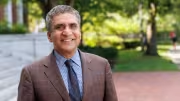
President Drew Faust has often described how the battle to achieve civil rights for African Americans shaped her worldview, from her youthful exposure to the upheaval over school desegregation in Virginia to her college involvement in the catalytic voting-rights march at Selma. Now, she has engaged with the other defining trauma of that era, the war in Vietnam. During an extended trip to Southeast Asia, between a Harvard Campaign fundraising event in Singapore last Sunday and forthcoming appointments in Hong Kong, Faust is visiting Vietnam. Her itinerary included an appearance at the Fulbright University Vietnam, the institution in formation that is built on the foundational Fulbright Economics Teaching Program (founded and nurtured with extensive Harvard involvement, and recently chartered as that country’s first private, nonprofit, academically independent, American-style university, with high-profile support from former Secretary of State John Kerry and President Barack Obama). Faust also visited a school in the Mekong Delta, and delivered an address at the University of Social Sciences and Humanities in Ho Chi Minh City.
The address, titled “Aftermath: War, Memory, and History,” touches on the connections between Vietnam and the United States, and suggests some interesting Harvard resonances as well as Faust’s personal concerns. As she noted,
It…means a great deal to me to be here in your country, for important parts of our national histories have been intertwined in ways that have affected all of us. What you know as the War of National Salvation Against the Americans—what we call “Vietnam”—indelibly shaped those of us coming of age in the United States in the 1960s and 1970s. Even though I never came within 8,000 miles of your country during those years, its names and places have reverberated in my mind for decades: names like Khe Sanh, Pleiku, Ap Bac, Dien Bien Phu, Gulf of Tonkin, Da Nang, Hue, Saigon, Hanoi. I have long wanted to make at least some of those names more than words. You have a slogan directed at tourists: “Vietnam: A Country, Not a War.” Like so many other Americans who have traveled here, I have wanted to make Vietnam into a place in my mind—not the name of a conflict that overtook my generation of young Americans, but a society and nation with all its complexity, its beauty, its history, its vibrancy, and its promise.
“[S]eeing your country has come to seem for me necessary to understanding my own,” Faust said, continuing:
American men of my generation confronted the military draft, which cast many into a struggle of conscience about whether they would comply with laws that required them to serve in a war they believed unwise and unjust. For young women, like me, the dilemma was less immediately personal, but it propelled us to ask unsettling questions about our nation, our democracy, and our very humanity. Michael Herr, a journalist from the United States who covered the war [author of the vivid Vietnam memoir, Dispatches], once wrote that Vietnam was, and I quote him, “what we had instead of happy childhoods.”
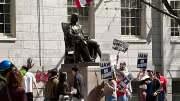
In the Harvard context, she said, the coming Commencement would mark a half-century from the sharp escalation of the American military engagement in that war (and the fierce divisions the war induced in the United States), and “this spring, a special event will take place within the customary set of observances. Members of the class of 1967—both men and women—will devote a segment of their time together to remembering the way the War defined their College years and to discussing how what they call ‘Vietnam’ has affected them for over half a century. As one class member who served in the Marines writes, ‘Many in my…generation made choices about Vietnam that…have haunted us, in dreams and awake, for the rest of our lives.’"
(Faust did not say so on this occasion, but this Commencement will also mark the seventieth anniversary of the announcement of the Marshall Plan, in a most unusual graduation address that launched one of America’s most constructive engagements with the world—in an era that seems almost vanished given contemporary disagreements about this country’s interest in helping to defend, and pay for the defense of, European allies.)
Turning to the horrendous costs of the war for the Vietnamese themselves (“The war was not fought on American soil; three million tons of bombs and 11 million gallons of defoliant were not dropped on my country; 58,220 American soldiers died, compared to more than an estimated three million Vietnamese military and civilian deaths during the Second Indochina War.”), Faust drew on her historical scholarship to address how “both our societies live with ghosts, with memories, and with legacies. With the aftermath.” Much of the rest of her speech focused on the American experience during and after the Civil War in coming to terms with death on an unprecedented scale: identifying those who fell in battle, recovering the lost or missing, effecting burials, and properly commemorating the dead. (These are the subjects of her last book, the acclaimed This Republic of Suffering: Death and the American Civil War, excerpted here.)
The number of missing and unidentified casualties in the Civil War, some 300,000 people, she said, “is probably quite close to the total number of Vietnamese unaccounted for in the Second Indochina War.” From the experience of that conflict, and its successors, she observed, had come a continuing search for remains in order to honor casualties of military service and respect their families, an effort that resonates across the Pacific: “Today the United States expends more than $100 million annually in the effort to find and identify individuals still missing from World War II, Korea, and Vietnam. I am certain you in this country are well acquainted with the vehemence of the American MIA movement after 1975.”
Reflecting on the aftermath of U.S. involvement in Vietnam (for the Vietnamese, a combined civil and revolutionary conflict, and a protracted nationalist uprising against colonialism), she concluded:
The character Kien in Bao Ninh’s acclaimed novel, The Sorrow of War, asks, “Why choose war? Why must he write of the war?” Even as Kien struggles to find another subject, he “cannot stop writing war stories.” Like him, we write and we talk and we remember because we struggle to understand how war has made us. Vietnam and the United States fought against one another in a long and devastating war. Now, both separately and together, we face its aftermath.
History is indispensable in that effort. It helps us confront the ghosts and the demons that the tragedies of the past leave as their legacy to the present. It illuminates the blindnesses and cruelties that enable war. It equips us to imagine and to strive for peace.
Read the text of Faust’s address here.
(Readers may also be interested in Faust’s address on the humanities and military leadership at West Point almost exactly one year ago, and the context for those remarks.)