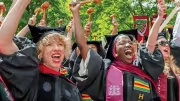
From the start, it was clear there was something a little different about Radcliffe Day 2018. The tables underneath the tent stood more closely together than usual, the temperature was warmer than a typical early summer day in Cambridge, and the energy, boosted in great part by the fiftieth-reunion class of 1968’s bright pink “Resist” armbands, was exceptionally palpable.
Once they’d settled down in the tent for the morning portion of the program, Lizabeth Cohen, the departing dean of the Radcliffe Institute for Advanced Study, welcomed the more than 2,000 members of the Radcliffe community by informing them that they were a part of the largest Radcliffe Day in history. After sharing a few words of welcome about this year’s Radcliffe Medal recipient, Hillary Rodham Clinton, who arrived at the beginning of the program, Cohen explored some of the circumstances that had prompted the topic of the day’s panel discussion, “Toward a New Global Architecture? America’s Role in a Changing World.” “Even challenges that once seemed solidly domestic have become increasingly global in nature,” she said. “Diseases don’t respect national borders. Climate change has been a global issue since we first started talking about it. The threat posed by non-state violent extremist groups such as the Taliban and Boko Haram similarly transcends political frontiers and demands global cooperation.”
Moderator Nicholas Burns, Goodman Family professor at Harvard Kennedy School, began by asking foreign-policy analyst Anne-Marie Slaughter, J.D. ’85, to reflect upon a perplexing reality: that the United States has “fallen from grace. We don’t have strategic purpose…we’ve abandoned allies. And trade. And refugees.” After chiding Burns for asking what would certainly pass for a leading question in any courtroom, Slaughter became serious: “We are not leading in the world, Nicholas, to answer your question.” She went on to implore the audience to acknowledge and embrace the fact that the United States has always been and must continue to be a leader on the international stage. “We have to recognize that right now, we are less the global hegemon than the global hypocrite. We are preaching values of democracy and universal values we are not practicing at home. We are preaching prosperity, but our country is falling apart—trust me, I live on Amtrak, I know of what I speak,” she said, drawing laughter and applause.
The Kennedy School’s professor of the practice of international affairs, Meghan O’Sullivan, the sole conservative panelist, approached the question of America’s global role as a representative of a deeply divided Republican Party. “The last 70 years have been a period of unprecedented prosperity and peace on large account because of the web of institutions and norms that have underpinned a lot of what’s gone on in the world,” she said. “The U.S. has just been the most critical actor—not only in constructing that web of institutions and norms, but in defending it.” She also spoke frankly about how many members of the Republican Party view President Trump’s steps toward dismantling those institutions: “Many Republicans, and I would consider myself one of them, don’t really see him as a Republican. He has departed from very traditional core Republican values and policies in very, very fundamental ways.”
Acknowledging that the discussion had perhaps reached its capacity for pessimism as far as surveying the state of domestic and international affairs, Slaughter, former Obama under secretary for defense policy Michelle Flournoy ’83 and Washington Post associate editor David Ignatius ’72, weighed in on what they felt most optimistic about in 2018. “We’re living in an age of renewal”, said Slaughter. “Everyone here who has anybody in their life who’s graduating, go buy a book called Our Towns: A 100,000-Mile Journey into the Heart of America by Jim and Deb Fallows. They tell you what I have seen: at the national level, I’ve never been more depressed. But, at the local level where people know each other and know that we’re broken, they document that people are coming together and solving problems who would never work together at the national level.” Flournoy echoed the sentiment by pointing to the Parkland students who spoke out against gun violence, and to the community groundswell for the #MeToo movement.
Notably, each of the panelists injected anecdotes and asides about Clinton’s achievements throughout their responses to Burns’s questions. O’Sullivan mentioned that she, unlike the others, hadn’t had the opportunity to work directly with Clinton, but appreciated all that Clinton had done to break the glass ceiling in public policy.
David Ignatius perhaps best summarized the panel’s purpose by explaining why America’s commitment to a certain set of values and freedoms remains worth pushing for on the international stage: “We still live in a country where citizens get to decide what kind of government they want. I’m not happy about the choices people sometimes make, but I want people to fight to preserve their right to choose.”