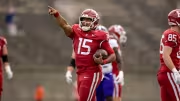
After College administrators informed students that they must move out of their dorms by 5 p.m. on Sunday, March 15, Harvard Athletics began to make its own cancellations—a necessary response, but a brutal blow to athletes, coaches, and staff.
On Tuesday, March 10, the Ivy League canceled the men’s and women’s basketball tournaments (scheduled to take place in Lavietes Pavilion), and selected Yale and Princeton, the regular-season men’s and women’s winners, to represent the league at their respective NCAA tournaments. Two days later, the NCAA canceled them, too.
An initial lack of clarity from the University frustrated athletes who were set to compete in postseason championship events. Kieran Tuntivate ’20—who had run a Harvard-record 3:57 mile earlier in the season to qualify for the NCAA Division I Indoor National Championships—detailed in an Instagram post how the College had removed him and his teammates Anna Juul ’21 and Abbe Goldstein ’21 from the competition minutes before they were set to leave campus for Albuquerque, New Mexico.
The entire championship would be canceled. “Actually thanks to Harvard I’m not stuck in Albuquerque now,” Tuntivate posted on Instagram.
By Wednesday, March 11, at 3 p.m., every Ivy League spring sporting event was canceled, and the University declared that no Harvard athlete would participate in any individual or team postseason competition (nearly all of which were later suspended by the NCAA). The ECAC hockey men’s quarterfinal series, between Harvard and Rensselaer Polytechnic Institute—previously scheduled to be played without an audience—was called off, too.
“We understand the disappointment that will be felt by many of you and many in our community,” wrote athletics director Robert L. Scalise in a statement to coaches and staff, “but we must be guided by what is best for the health and safety of all.” The sentiment applied especially to seniors—and likely Scalise himself, who retires at the end of the academic year.
~ The Editors
Read “Drip, Drip, Drip” and “Not Meant to Be” for reports on the fencing champions and the basketball teams’ interrupted seasons.