Vocalist and composer Claire Dickson ’19 was on a tall ship in the Arctic Circle when she composed the first song on her debut album, Starland. It was October 2019, and the Arctic was in all-day sunset, the sun never clearing the horizon. The boat, which traveled from Svalbard, Norway through the Arctic Circle as part of a two-week artist residency, dropped anchor off a rocky beach. Dickson had an idea, listening to the sounds of the waves against the rocks. She sat on her bunk bed next to a porthole and tried to mimic and harmonize with the sounds from the shoreline, using only her singing voice, a microphone, and the MIDI keyboard on her laptop. This raw recording, after a bit of clever mixing, would become “Arctic,” the opening track Dickson’s debut art-pop album, Starland.
The album—written, performed, and produced by Dickson, and recorded both in the Arctic and in her bedroom in Brooklyn—was partially inspired by the disorientation she felt returning from the otherworldly, untouched tundra to New York City. “Part of the album is about going to one of the last places on earth that’s inhabited by humans, and then coming back and not being able to really fully explain it to anyone,” she says. “It’s this longing for people to remember and know the limitlessness of it.” That concept guides the album, the tracks of which range from art pop (a loose category for experimental-leaning pop, which includes artists like Björk and Fiona Apple) and jazz to ambient electronic music. Dickson’s singing voice is the album’s connecting thread. A jazz singer by training, she uses her shape-shifting voice to explore lyric soprano and gravelly alto ranges throughout the album, and at certain points, to imitate non-human sounds: on “Snowglobe,” her voice is layered and staccato like falling snow, and in “Starland” it sounds eerily like wind.
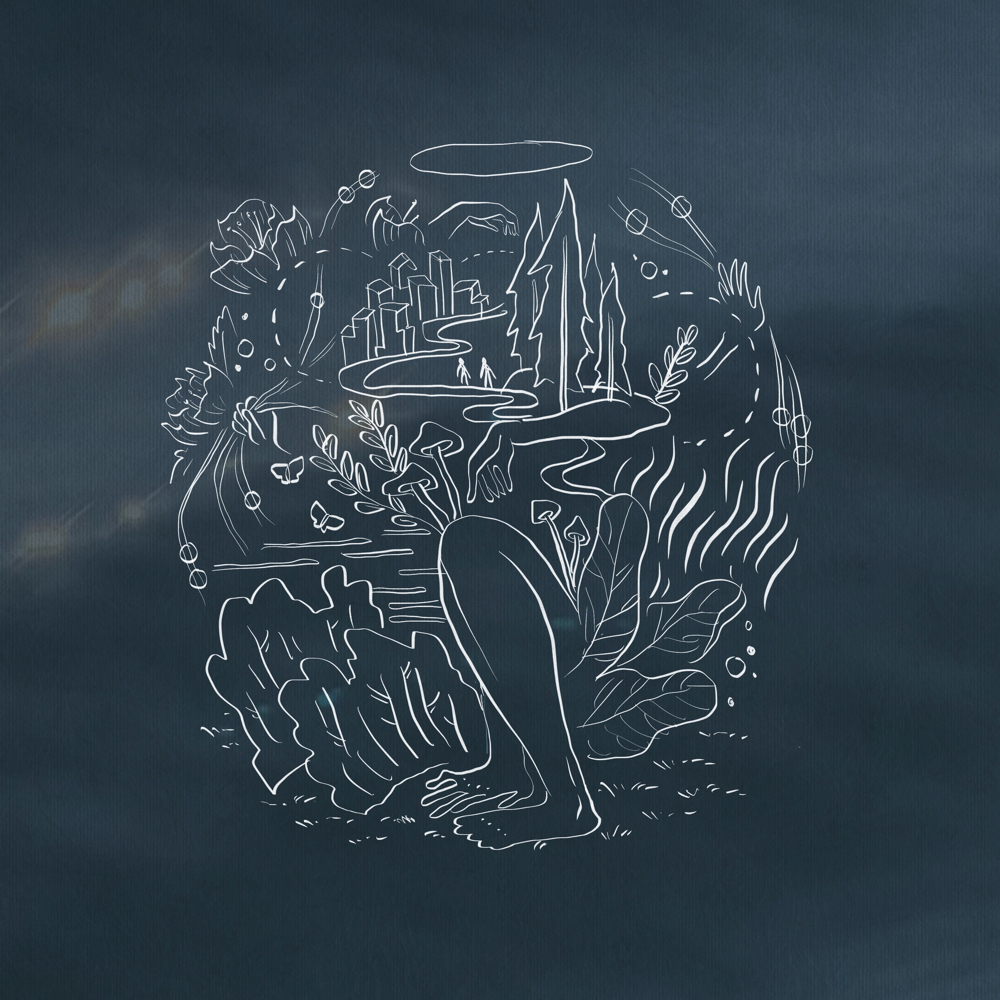
Starland album art
Art by Mingjia Chen
The album easily could have skewed inscrutable—like the David Lynch film you’ve only seen half of, but still recommend at cocktail parties. Creating dreamy soundscapes reminiscent of the Arctic is a lot for anyone to juggle. But according to Rosenblatt professor of the arts and four-time Downbeat Jazz Artist of the Year Vijay Iyer, Starland is so clear and affecting because Dickson is “a daring songwriter unafraid to break form, time, and harmony in pursuit of new truths; a poet full of mysterious yearning; an intensely subtle vocalist who can soar, glide, hover, shapeshift, and dive into the abyss—Claire is somehow all of these geniuses at once. ‘Cinematic’ barely covers it—she’s a world-builder… This album will stay with me for years to come.”
Dickson credits the album’s organic and improvisational vocals to her interest in jazz, which began as a child when she heard Ella Fitzgerald’s “Lady Be Good.” She says, “I was really drawn to the way she used her voice instrumentally. You can hear the spontaneity in what she’s doing, and that captivated me.” A native of Medford, Massachusetts, Dickson went to “basically every library in the Boston area” to collect Fitzgerald’s entire discography and then taught herself to improvise from it. In addition to singing with jazz bands around her hometown and joining her professional-clarinetist father at jazz jams, she pursued music at the nation’s highest levels, performing at the Kennedy Center as a U.S. Presidential Scholar in the Arts and in the GRAMMY Foundation Jazz Session. Though Starland is not a jazz album, it’s still guided by the same ethos. “This idea in jazz that something could go anywhere, that a solo could go anywhere, is something I carry with me,” she says. Much of her composition process hinges on improvisation, or “trusting the feel of what’s happening.”
As she releases this album online (and celebrates with a live show next month) Dickson already has another album in her back pocket, almost finished. Where Starland is more conceptual and experimental, this unnamed and unpublished one will have more traditional song structures and more lyrics. “I have this theory that drums are what make pop music, pop music,” she says. “This next album has more drums, so it sounds more like pop music.” She’s also working on an album with Myrtle, the pop duo she formed as a Harvard undergraduate with Camila Ortiz ’19. “We wrote a bunch of music over the pandemic on FaceTime and in parks in five-degree weather,” Dickson says, and now they’re recording in the studio a few times a week. Eventually, Dickson could see herself going back to school for psychology and becoming a therapist. “But right now,” she says, “I just want to do music. I would be lying to myself if I said anything else.”