1913
The Alumni Bulletin welcomes news of the founding of the Harvard University Press as an “eminently appropriate [way to] powerfully advance the general cause of learning.”
1918
To save coal for the war effort, the University closes various buildings on selected days and cuts off heat to student dormitories after 9 p.m.
1923
President Lowell’s refusal to let the son of a black alumnus live in the freshmen dormitories, as other freshmen are compelled to, creates a furor in the letters section of the Alumni Bulletin and in the public press.
1928
The Board of Overseers approves the creation of President Lowell’s long-cherished project, the Society of Fellows.
1938
After 40 and 13 years, respectively, on the research staff of the Harvard Observatory, astronomers Annie Jump Canon and Cecilia Payne-Gaposchkin receive Corporation appointments.
1943
The presidents of Harvard, Princeton, and Yale issue a joint statement agreeing to forgo “athletics as usual” for the duration of the war.
1953
An admissions office pamphlet gives the estimated cost of a year at the College as $1,800, including tuition, room, board, fees, and personal expenses.
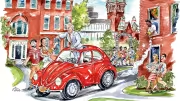
In Boston when it snows at night,/ They clean it up by candle-light./ In Cambridge, quite the other way—/ It snows and there they leave it lay.
1963
The Carpenter Center for the Visual Arts, the first North American structure by Le Corbusier, opens its doors.
2008
The magazine reported on the prior December 1 ceremony at which Senator Edward M. Kennedy ’54, in treatment for brain cancer, received an honorary LL.D. ’08—attended by, among others, Vice President-elect Joseph R. Biden.
2013
The Harvard Initiative for Learning and Teaching has underwritten digital technology, including a “video-capture studio” in Widener Library, to promote faculty experimentation with online teaching and the novel use of visual materials in classrooms.