Headlines from Harvard’s history

Headlines from Harvard’s history

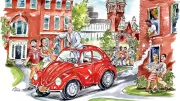
Illustration depicting a summer-school student sunbathing on the steps of Widener Library

Illustration by Mark Steele

1913

The Alumni Bulletin reports the laying of the cornerstone of the Harvard Club of Boston. A spokesman says the club will be “characterized by academic simplicity. We desire to be famous, not for our canvas-backs, but for our glorified corn-beef hash.”

1938

“A new function is developing” for the Harvard Summer School, state the Bulletin’s editors. “Thoughtful adults are discovering that the rapidly changing life of this dynamic world makes education a continuous process which can never be completed at any specified age or date. Many are turning to the summer school for opportunities to continue their intellectual growth, to increase their athletic enjoyment, and to gain new vitality for the obligations of modern life.”

1943

The Fogg Museum rearranges its storage areas to protect works of art in the event of an enemy bombardment of Cambridge.

1963

On the Peace Corps’ second anniversary, the 43 College alumni serving abroad place Harvard second only to Berkeley as a source of A.B.s in the Corps.

1978

The Faculty of Arts and Sciences discusses the proposed “Core Program,” described by its chief proponent, Dean Henry Rosovsky, as “not [going] back to basics—I detest that phrase—but forward to modern liberal education.”

2003 

President Lawrence H. Summers unveils a “down payment” on financial aid, focusing on the Graduate School of Arts and Sciences and the public-service-related professional schools, including a package of grants and no-fee, below-market-rate loans.

Related topics

You might also like

Highlights from Harvard’s Past

The rise of Cambridge cyclists, a lettuce boycott, and Julia Child’s cookbooks

Wadsworth House Nears 300

The building is a microcosm of Harvard’s history—and the history of the United States.

In Sermon, Garber Urges Harvard Community to ‘Defend and Protect’ Institutions

Harvard’s president uses traditional Memorial Church address to encourage divergent views.

Most popular

What Trump Means for John Roberts’s Legacy

Executive power is on the docket at the Supreme Court.

Harvard’s Class of 2029 Reflects Shifts in Racial Makeup After Affirmative Action Ends

International students continue to enroll amid political uncertainty; mandatory SATs lead to a drop in applications.

Harvard Cancelled Affinity Celebrations. Students Held Them Anyway.

In hotels, parks, and churches, graduates decried the end of DEI programs.

Explore More From Current Issue

A man in a gray suit sits confidently in a vintage armchair, holding a glass.

The Life of a Harvard Spy

Richard Skeffington Welch’s illustrious—and clandestine—career in the CIA

Wolfram Schlenker wearing a suit sitting outdoors, smiling, with trees and a building in the background.

Harvard Economist Wolfram Schlenker Is Tackling Climate Change

How extreme heat affects our land—and our food supply