“Building Bridges” Across Disagreements

Harvard establishes a fund for student projects that create community.

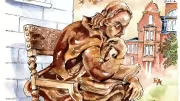
The President’s Building Bridges Fund is inspired by the work of two presidential task forces  | PHOTOGRAPH BY NIKO YAITANES/HARVARD MAGAZINE

Today President Alan M. Garber announced a grant program to support student projects that “build bridges across differences.” The President’s Building Bridges Fund is inspired by the work of two presidential task forces, on Combating Anti-Muslim, Anti-Arab, and Anti-Palestinian Bias and on Combating Antisemitism and Anti-Israeli Bias. Both groups were established earlier this year amid deep tensions on campus over the Israel-Gaza war, and their preliminary recommendations, released in June, emphasized the importance of constructive dialogue and the need for more opportunities to build community across differences.

In a letter emailed to the entire student body, Garber invited students to submit proposals for projects; there is no set format for the projects—that’s up to the students—but they must adhere to one of four focus areas:

  • Broadening relationships between affinity groups
  • Investing in intellectual excellence
  • Acting against discrimination, bullying, harassment, and hate
  • Fostering constructive dialogue on campus about interfaith and/or intercultural issues

Winning proposals will be awarded grants of up to $5,000, and the deadline for submissions is January 6, 2025.

“Our own community has the skills, creativity, and commitment to develop approaches that will help us heal and to expand opportunities for constructive engagement,” Garber wrote in his letter. “If you have an idea that speaks to these goals, I hope that you will consider putting it into action.”
Read more articles by Lydialyle Gibson
Related topics

You might also like

The division is launching a new fundraising effort to support 50 additional students.

President Alan M. Garber used traditional Memorial Church address to consider the unique qualities of human intelligence and learning.

Due to rain, the University held dual Convocation ceremonies for the Class of 2030 in Sanders Theatre.

Most popular

Harvard’s Class of 2029 Reflects Shifts in Racial Makeup After Affirmative Action Ends

International students continue to enroll amid political uncertainty; mandatory SATs lead to a drop in applications.

The University has pushed the adoption of AI into teaching and operations, but faculty resistance is growing louder.

In 1954, Gregory Corso moved into Eliot House. How he stayed there is a literary legend.

Explore More From Current Issue

A vase of yellow flowers on a table next to an orange and a glass.

Harvard Art Museums restores a rare glimpse of an American master.

Smiling woman stands beside a large skull in a display cabinet.

From competing in youth gymnastics to studying tetrapods, the Harvard curator has always chased her curiosity.

Caricature of a young man in front of red doors, wearing a green striped sweater.

In 1954, Gregory Corso moved into Eliot House. How he stayed there is a literary legend.