
A glimpse of the future of food can be seen through the eyes of Andrew Ive, M.B.A. ’97. He is managing director of the world’s largest food-company incubator, Food-X, based in New York City, which helps about 170 food start-ups get off the ground each year. They range from Booster, which uses machine learning to provide farmers with dynamic, granular climatic data to help them manage their crops, to Wasteless, which uses an algorithm to lower the price of foods approaching their sell-by dates, thereby bringing improved efficiency to the food supply chain. Another Food-X startup, Freshurety, goes a step further, placing sensors in trays of produce to continuously monitor the ambient temperature and sample the gases the fruits and vegetables give off, to calculate their remaining shelf life. The data let shippers know whether their goods need to be sold locally or will remain fresh after a week-long journey.
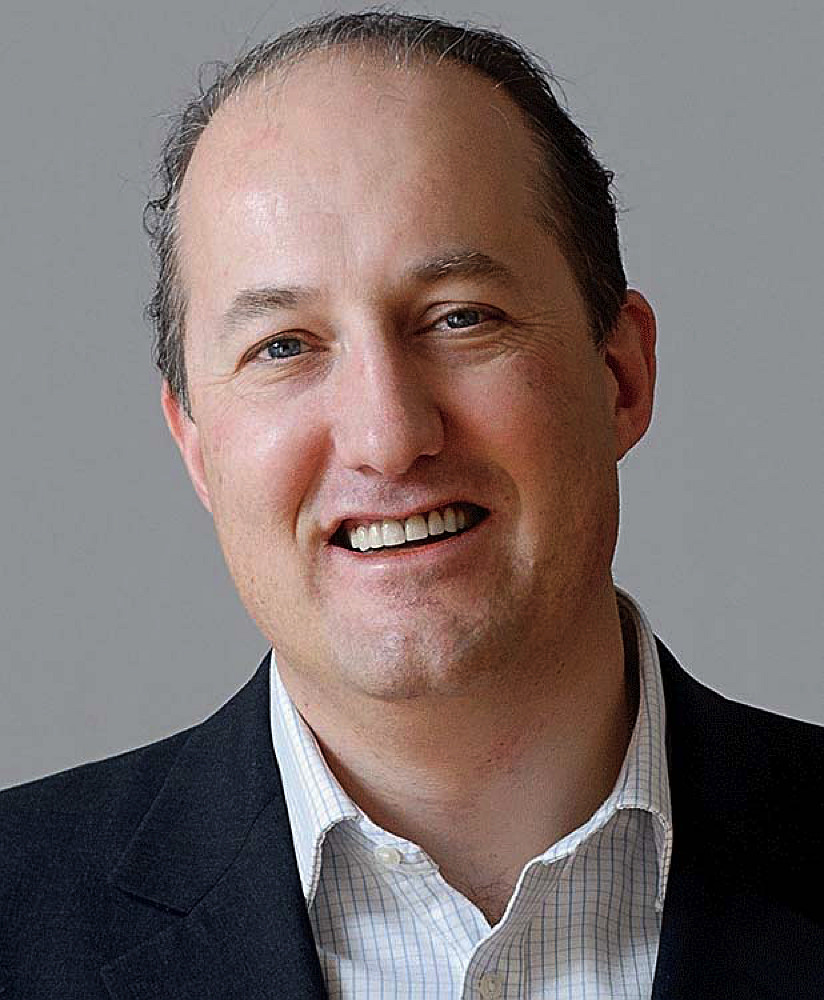
Andrew Ive, managing director of Food-X
Photograph courtesy of Food-X
Ive is particularly excited about Cambridge Crops, a company in Food-X’s current cohort that was co-founded by Livio Valenti, M.P.A. ’13. The company uses a technology developed at Tufts and MIT that turns a natural substance derived from silk into a powder. When mixed with water and sprayed on produce, it increases the shelf life by two to three times throughout the supply chain without the need for refrigeration or any kind of humidity control, he reports. This would vastly reduce the resources needed to keep produce cool—and be especially useful in places lacking refrigeration. Noting that a grower in India estimates that as much as 50 percent of the bananas he harvests never make it to consumers, Ive calculates that if that 50 percent were no longer wasted, the grower could produce the same volume for world markets with half as much water, fertilizer, and acreage—freeing the surplus for other uses, maybe even other crops.
Other companies in the Food-X ecosystem seek to address new markets being defined by millennials. Several “cellular agriculture” startups—Memphis Meats is one that recently attracted investment from Tyson Foods, Cargill, Bill Gates, and Richard Branson—are growing meat, everything from fish to filet mignon, in factories. Meanwhile, Perfect Day uses fermentation to create milk without a cow. (Cows are a prodigious source of methane, a potent greenhouse gas.) “You don’t need the dairy, and you don’t need the field,” says Ive.
Perhaps even more cutting-edge is NonFood, which aims to create “a range of really interesting, delicious products based almost entirely on algae, with a goal, ultimately, of designing a home-based bioreactor” that would allow customers to “grow their own algae and print it into a useful product: food.” Algae “are incredibly fast-growing and don’t require fertilizer,” Ive points out. “The process is quite sustainable.”
More is at stake than millennial tastes, however. “My biggest concern in all of this is that as places like India and Africa become more affluent, they will adopt Western eating habits, giving up their healthy, vegetarian-centric food systems and cultures and move towards meat,” he says. Nothing will stop that process, but “maybe these technologies around cultured meat” could be used to create foods they’d want “in a way that’s a lot more sustainable and less damaging to the environment. Humanity,” he observes, “has a really interesting way of solving problems at the last moment, and I’m hoping that all of the entrepreneurs I’m working with, and will work with, will be part of those kinds of solutions.”