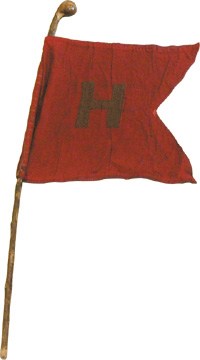
Frederick Plummer, A.B. 1888, who attended 59 consecutive Harvard-Yale games before his death in 1949, customarily carried a certain small banner to The Game as a talisman of Harvard luck. Made of magenta and brick-red silk with an olive H stitched to one side and mounted on a small walking stick, the "little red flag," as it has come to be called, is one of The Game's more arcane traditions. In 1950, when the flag appeared among the various unassigned items in Plummer's estate, William Bentinck-Smith '37, then editor of this magazine's predecessor, the Harvard Alumni Bulletin, suggested awarding the honor of carrying the flag on Game day to the Harvard man in attendance who had seen the largest number of Yale games. On Commencement Day 1951, Spencer Borden, A.B. 1894, who had witnessed every Yale game since 1889, took up the banner. The legacy has continued, as detailed below. Seeing the most Yale games is no longer the criterion for flag bearing; current bearer William Markus '60, wouldn't qualify by that standard, though none can doubt his commitment to the cause (see "Superfan," page 94).
| Class | Yale games | Flag years | ||
| Frederick Plummer | 1888 | 59 | 1884-1948 | |
| Spencer Borden | 1894 | 62 | 1951-1956 | |
| Allen Rice | 1902 | 73 | 1957-1969 | |
| Richard P. Hallowell | 1920 | 66 | 1970-1977 | |
| Douglas Hamilton | 1923 | 66 | 1977-1985 | |
| James Dwinell | 1931 | 42 | 1985 | |
| Harold Sedgwick | 1930 | 55 | 1986-1996, 1998 | |
| Sam Donnell | 1937 | 54 | 1997 | |
| Burdette Johnson | 1927 | 66 | 1999-2000 | |
| William Markus | 1960 | 12 | 2001- |
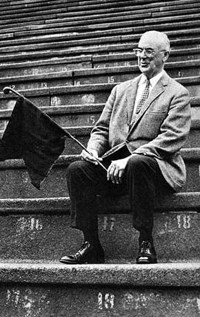 |
| Richard P. Hallowell '20 with the flag |
| Photograph by Nancy J. Witting |