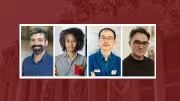
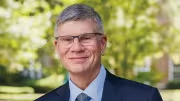
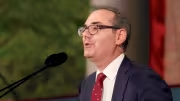
This spring, alumni can choose five new Harvard Overseers and six new directors for the Harvard Alumni Association (HAA) board. The candidates’ names appear in ballot order below, as determined by lot. Ballots should arrive in the mail by April 15 and are due back in Cambridge by noon on May 21 to be counted. Election results will be announced at the HAA’s annual meeting on May 27, on the afternoon of Commencement day. All holders of Harvard degrees, except Corporation members and officers of instruction and government, are entitled to vote for Overseer candidates. The election for HAA directors is open to all Harvard degree-holders.
For Overseer (six-year term), the candidates are:
Cheryl Dorsey ’85, M.D. ’91, M.P.P. ’92, New York City. President, Echoing Green.
David Tang ’75, Seattle. Managing Partner, Asia K&L Gates.
Walter Isaacson ’74, Washington, D.C. CEO, The Aspen Institute.
Diana Nelson ’84, San Francisco. Director, Carlson Companies, Inc.
David Heyman ’83, London, film producer.
Karen Nelson Moore ’70, J.D. ’73, Cleveland. U.S. Circuit judge, U.S. Court of Appeals for the Sixth Circuit.
Joseph Fuller ’79, M.B.A. ’81, Cambridge. Cofounder, vice chairman, and CEO, Monitor Group.
Nicholas Kristof ’82, New York City. Columnist, the New York Times.

For Elected Director: (Top, L-R) Irene Wu; Roger Fairfax Jr.; Lindsay Hyde; George Newhouse Jr.; Reynaldo Valencia. (Bottom, L-R) M. Margaret Kemeny; Kenneth Bartels; Mark Fusco; Victoria Wells Wulsin
For Elected Director (three-year term), the candidates are:
Irene Wu ’91, Washington, D.C. Director of international research, U.S. Federal Communications Commission; adjunct professor, Georgetown University.
Roger Fairfax Jr. ’94, J.D. ’98, Washington, D.C. Law professor, George Washington University Law School.
Lindsay Hyde ’04, Boston. Founder and president, Strong Women, Strong Girls.
George Newhouse Jr. ’76, Los Angeles.Partner, Brown, White & Newhouse, LLP.
Reynaldo Valencia, J.D. ’90, San Antonio. Associate dean for administration and finance; professor of corporate and securities law, St. Mary’s University School of Law.
M. Margaret Kemeny ’68, New York City. Professor of surgery, Mt. Sinai School of Medicine, chief of surgical oncology, and director of the Queens Cancer Center.
Kenneth Bartels ’73, M.B.A. ’76, New York City. President and CEO, Paxton Properties, Inc.
Mark Fusco ’83, M.B.A. ’90. Westwood, Massachusetts. CEO, Aspen Tech.
Victoria Wells Wulsin ’75, M.P.H. ’82, D.P.H. ’85, Cincinnati. Physician, Mid-City Pediatrics.