Image gallery: homeless artists respond to stereotypes

Paintings by homeless artists in New Jersey respond to the social perception of homeless people as cold and incompetent.

<i>I See a Brighter Day</i>
<i>How You See Me</i>
<i>Pulling My Way Out!!!!</i>

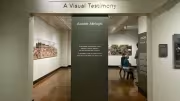
Ruthann Traylor learned of research on stereotypes by Amy Cuddy, a social psychologist at Harvard Business School, years ago when they were neighbors. (Cuddy was then studying for her doctorate at Princeton.) “I read the section on how the poor and homeless were perceived to 12 poor and homeless women at the shelter,”  says Traylor, who is now the director of ArtSpace, a homeless shelter in West Trenton, New Jersey, run by HomeFront, a nonprofit social service agency. “We spent a year and a half responding to this perception by collecting poems and art work by the people I work with.” In April 2010, an exhibition of this work opened at Princeton’s Woodrow Wilson School for Public and International Affairs, with a panel discussion two weeks afterward featuring Cuddy and fellow psychologists Susan Fiske and Peter Glick; 200 attended, and the exhibition ran into August.

In the gallery here, see some examples of paintings by these homeless artists, made in response to the research that showed the homeless were generally perceived as both cold and incompetent.

Related topics

You might also like

How a Harvard Hockey Legend Became a Needlepoint Artist

Joe Bertagna’s retirement project recreates figures from Boston sports history.

England’s First Sports Megastar

A collection of illustrations capture a boxer’s triumphant moment. 

This TikTok Artist Combines Monsters and Mental Heath

Ava Jinying Salzman’s artwork helps people process difficult feelings.

Most popular

Harvard Board of Overseers Candidates Describe Priorities

Alumni will vote for the University governing board in April and May.

Is Copyright Law the Wrong Weapon Against AI?

Harvard law professor Rebecca Tushnet explains how “fair use” applies to LLMs.

Harvard’s Class of 2029 Reflects Shifts in Racial Makeup After Affirmative Action Ends

International students continue to enroll amid political uncertainty; mandatory SATs lead to a drop in applications.

Explore More From Current Issue

Illustration of a person sitting on a large cresting wave, writing, with a sunset and ocean waves in vibrant colors.

How Stories Help Us Cope with Climate Change

The growing genre of climate fiction offers a way to process reality—and our anxieties.

A black primate hanging lazily on a branch in a lush green forest.

What Bonobos Teach Us About Female Power and Cooperation

A Harvard scientist expands our understanding of our closest living relatives.

A diverse group of individuals standing on stage, wearing matching shirts and smiling.

How a Harvard and Lesley Group Broke Choir Singing Wide Open

Cambridge Common Voices draws on principles of universal design.