Mahindra Humanities Center erects “poetry posts” to commemorate 9/11

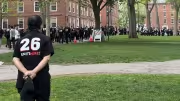
The Mahindra Humanities Center erects eight “poetry posts” to prompt reflection about loss and recovery.

Photograph by Jim Harrison

Photograph by Jim Harrison

Photograph by Jim Harrison

Photograph by Jim Harrison

As part of the University’s observance of the tenth anniversary of 9/11, the Mahindra Humanities Center erected eight “poetry posts” on the lawns between Massachusetts Hall and the Barker Center: slim green cylinders, about seven feet tall,  each bearing the names of the 10 Harvard affiliates who died in the attacks, and a poem (or excerpt) meant to prompt reflection about loss and recovery. Among the texts were Martín Espada’s “Alabanza: In Praise of Local 100,” on the 43 members of Hotel Employees and Restaurant Employees Local 100 who perished in Windows on the World; Emily Dickinson’s “We Grow Accustomed to the Dark”; an excerpt from Lucille Clifton’s “september song: a poem in 7 days” ; Frank Bidart’s “Curse”; and an excerpt from W. H. Auden’s “September 1, 1939.”

The list atop each pale olive pillar paid homage to the dead: David Al­ger ’66; Paul Ambrose, M.P.H. ’00; Anthony Demas, P.M.D. ’80; Steven Lawrence Glick, M.B.A.’89; Edward R. Hennessy ’88; Waleed Joseph Iskandar, M.B.A. ’93; Andrew Keith Kates, M.B.A. ’91; Michael B. Packer ’76; Meta Waller, M.P.A. ’82; and Steven Weinstein, S.M. ’73.

Related topics

You might also like

At informational town hall meetings, faculty and staff press administrators for details.

The Emmy-winning journalist was a mainstay of political coverage at NBC for two decades.

He was Harvard’s quintessential people person.

Most popular

The former economics concentrator brings his talent for crunching numbers to netminding.

Naval architect William Francis Gibbs, designer of the SS United States

Brief life of America’s greatest naval architect: 1886-1967

Human origins driven by technological and cultural revolutions

Ofer Bar-Yosef argues that cultural and technological revolutions have been more important than biological ones during the past 100, 000 years.

Explore More From Current Issue

Black and white photo of Joseph Murray in a white lab coat sitting in an office.

Nobel Prize recipient Joseph E. Murray dedicated much of his career to organ transplant surgery.

Aerial view of modern high-rise buildings surrounded by greenery and city skyline.

In a sea of red brick, the Science Center and Peabody Terrace make their mark.

Racing driver gives a thumbs up from inside a car, wearing a helmet and safety gear.

Harvard graduate and NASCAR racer Patrick Staropoli on pedals, attention, and fearlessness.