
 |
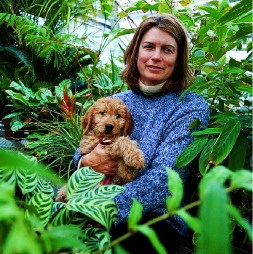
| Noel Michele Holbrook |
| Photograph by Stu Rosner |
Missy Holbrook '83 grew up in a suburb of Washington, D.C., where she somehow conceived an interest in palms. After her sophomore year, an International Palm Society travel grant sent her to Panama for a year off at a Smithsonian Institution research station in a tropical forest. Through hours of quiet contemplation of it, the forest stopped looking to her like a wall of green, as individual plants stepped forward. Holbrook went on to earn a master's degree in botany from the University of Florida and a Ph.D. from Stanford, where she got a teaching award along the way. She returned to Harvard in 1995 to teach (and win a Graduate Mentoring Award) and was tenured in 2001 as professor of biology. An eminent plant physiologist, she supervises five postdoctoral fellows and four graduate students in her laboratory. They travel widelyto Tasmania, Madagascar, Chile, the Harvard Forest, the Arnold Arboretum, and she, particularly, to Costa Ricaand in the lab make use of a diversity of plants, ranging from macro-algae to strangling fig trees, to explore the mechanisms that plants use to respond to environmental stresses. She is especially interested in the "long-distance transport processes" that move water, nutrients, and chemical signals throughout a plant. Every day an oak tree lifts hundreds of gallons of water up from the soil to be evaporated through its leavesquietly, with no moving parts: a brilliant feat and one she wants to fathom. Holbrook likes hiking, and botanizing en route, and every walk to work from her Cambridge home presents something to engage the mind. She has company in this from her new golden retriever/poodle puppy, Wolffia, named after a tiny aquatic plant, a duckweed, on the theory that she'll be a swimmer.





