1928 Following Harvard’s first spring reading period, the College Library reports about 650 more visitors than in the previous year.
1933 In response to a New Yorker article which “describes the lamentable decrease of hurdy-gurdies licensed by the city of New York,” the Bulletin’s editors cite the welcome increase in street performers and the variety of street music in Cambridge.
1938 After noting that Harvard appears to be the first institution of higher learning to enter into a contract with a national labor union, the Bulletin reports that nine employees’ units have participated in perhaps the first official election to determine the bargaining agent between a university and its workers.
1958 Upon the recommendation of the chairman of the University’s Board of Preachers, the Harvard Corporation has voted to permit Memorial Church to be used on certain occasions for private, non-Christian ceremonies that are conducted by officials of other religions.
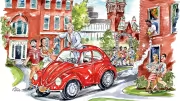
1963 What begins in the Winthrop House courtyard as a prank by 20 or so Radcliffe students “hotly perpetrating the first Great B.V.D. Raid in Harvard history” (according to the Bulletin’s undergraduate column) escalates into a riotous event involving close to 2,000 undergraduates and onlookers by the time the action reaches Harvard Square. The shouting, chanting masses finally disperse at the Radcliffe Quad. No Radcliffe women are officially penalized, but five Harvard men spend the night in jail.
1983 Student activists have set up “E for D,” the Endowment for Divestiture, and are urging seniors and alumni to send their class-gift contributions to its escrow account rather than to Harvard until the University adopts a policy of complete divestiture of its South African holdings or until the UN lifts its economic sanctions again that country’s apartheid regime.