Cutting-Edge Cancer Research Looks Beyond the Traditional Grant Funding System

Medical School professor George Demetri again leads cutting-edge cancer research, in an environment of timid funding for experimentation.

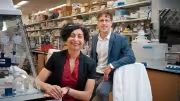
Associate professor of medicine George D. Demetri '78, of the Dana-Farber Cancer Institute, is overseeing high-risk, high-reward research being conducted by instructor in medicine Ewa T. Sicinska, according to the New York Times. In a June 28 front-page article, "Playing It Safe in Cancer Resarch: Grant Money Goes to Projects Unlikely to Break Much Ground," the newspaper's Gina Kolata documented the difficulty of securing federal funding for leading-edge research that promises breakthroughs. One example she cited was Sicinska's foundation-financed attempt to grow human cancers in mice, which would accelerate the development and testing of drugs as compared to current, more limited techniques.

Demetri's pioneering work in developing "smart" drug cancer therapies was narrated in detail by David G. Nathan '51, M.D. '55, in Harvard Magazine's January-February 2007 cover article, "Ken's Story," about a patient suffering from an abdominal cancer that was treated with Gleevec on an experimental basis. Nathan, president emeritus of Dana-Farber, has another article in the current issue of the magazine, "Lessons from an Unexpected Life," recounting his lifetime of caring for a patient with a chronic blood disorder. Both narratives detail the interaction of basic and clinical research, pharmaceutical-industry drug development, and the modern healthcare system in academic-medical settings.


 

Related topics

You might also like

Getting to Mars (for Real)

Humans have been dreaming of living on the Red Planet for decades. Harvard researchers are on the case.

Why Humans Walk on Two Legs

Research highlights our evolutionary ancestors’ unique pelvis.

The Secrets Glaciers Tell

A Harvard class explores the glacial legacy of pollution emitted by the Roman Empire

Most popular

Why Men Are Falling Behind in Education, Employment, and Health

Can new approaches to education address a growing gender gap?

The 1884 Cannibalism-at-Sea Case That Still Has Harvard Talking

The Queen v. Dudley and Stephens changed the course of legal history. Here’s why it’s been fodder for countless classroom debates.

Explore More From Current Issue

Anne Neal Petri in a navy suit leans on a wooden chair against an exterior wall of Mount Vernon..

Mount Vernon, Historic Preservation, and American Politics

Anne Neal Petri promotes George Washington and historic literacy.

Lawrence H. Summers, looking serious while speaking at a podium with a microphone.

Harvard in the News

Grade inflation, Epstein files fallout, University database breach 

Black and white photo of a large mushroom cloud rising above the horizon.

Open Book: A New Nuclear Age

Harvard historian Serhii Plokhy’s latest book looks at the rising danger of a new arms race.