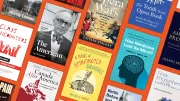
Close Calls with Nonsense: Reading New Poetry, by Stephen Burt, associate professor of English (Graywolf Press, $16, paper). Confronting Randall Jarrell’s problem--poetry doesn’t need to be defended, it needs to be read--Burt’s collected critical essays aim to ease the task, with introductions to poets ranging from A.R. Ammons to C.D. Wright.
Birds of North America, by François Vuillemier, Ph.D. ’67, editor-in-chief (Dorling Kindersley, $50). The American Museum of Natural History’s ornithology curator emeritus curates a massive and spectacular photographic guide: what Audubon would have done if he had used a camera. Also useful in the outdoors season: Spirits of the Air: Birds and Indians in the South, by Shepard Krech III, Ph.D. ’74 (University of Georgia, $44.95). The director of Brown University’s Haffenreffer Museum, an ethnohistorian, reconstructs the avian ecology of the South before colonial contact, including plentiful historical images of Native Americans and the wildlife they knew. Neither tome goes in your backpack unless that is fitted with wheels.
The Elements of Story: Field Notes on Nonfiction Writing, by Francis Flaherty ’75, J.D. ’81 (Collins, $17.95, paper). A New York Times editor and “story doctor” provides real-life insights into creating narrative. Lesson one: “Whatever your subject, give it a human face if you can.”
Stephen Jay Gould and the Politics of Evolution, by David F. Prindle (Prometheus, $26.98). A University of Texas professor of government explores the dual progression of the famous paleontologist’s scientific and political thinking, in a world where humans were, he felt, the result of chance.
Jesus Was a Liberal: Reclaiming Christianity for All, by Rev. Scotty McLennan, M. Div.-J.D. ’75 (Palgrave Macmillan, $26.95, paper). The author’s doppelgänger is Doonesbury’s Reverend Scott Sloan. Now dean for religious life at Stanford, McLennan explores the Jesus who “came with a fresh new progressive vision,” and hopes to create space for liberal Christians beyond the “current culture wars.”
Living Above the Store, by Martin Melaver, Ph.D. ’90 (Chelsea Green, $27.95). A primer on building a sustainable, green business by a literature student who now runs the family real-estate-development firm.
God Knows There’s Need: Christian Responses to Poverty, by Susan R. Holman, M.T.S. ’91(Oxford, $29.95). Holman, a writer and editor at the Harvard School of Public Health, explores “empathetic remembering” through early Christian and contemporary confrontations with hunger, want, and need.
Hope and Despair in the American City: Why There Are No Bad Schools in Raleigh, by Gerald Grant, NF ’68, Ed.D. ’72 (Harvard University Press, $25.95). A Syracuse professor of education and sociology emeritus, Grant compares the result of a social “experiment”: Raleigh’s urban-suburban school district, versus his own city’s urban one. Class and racial segregation have had devastating results in the New York district.
The Tall Book, by Arianne Cohen ’03 (Bloomsbury, $20). A towering presence when she was one of the magazine’s Ledecky Undergraduate Fellows, Cohen now celebrates “life from on high,” exploring everything from incomes to romance among the tall set.