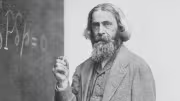
When Theobald Smith arrived at Harvard in 1895, he was already accomplished in the nascent fields of microbiology, immunology, and public health. Eleven years earlier, newly graduated from Albany Medical College at 25, he had begun his career at the new Bureau of Animal Industry in Washington, D.C., created by Congress to investigate common livestock diseases such as hog cholera, Texas cattle fever, and swine plague. These and other afflictions threatened the supply of meat to an increasingly urban population that depended on railroads to deliver vast numbers of cattle and pigs to centralized processing plants. Though Smith had no prior experience in animal pathology and little guidance existed on culturing and characterizing microbes, he discovered not only how ticks (and by inference, insects and other bugs) could harbor and transmit infectious diseases, but also that injections of heat-killed bacteria could bestow immunity.
He had also discovered the bacteria genus Salmonella, named (by custom) for the BAI’s director, Daniel E. Salmon. But he had chafed at Salmon’s leadership, so he eagerly accepted an offer from Henry P. Walcott, chief of the Massachusetts board of health and a Harvard Overseer, to oversee production of diphtheria antiserum for the Commonwealth and conduct research to control diseases “which bacteriology has done so much to explain.” (Walcott knew of a report, by a subordinate of Louis Pasteur, that antiserum obtained from immunized horses could reduce human diphtheria deaths by half.) Smith’s salary and other financial support were split between the board of health and the Bussey Institute in Jamaica Plain--Harvard’s attempt to bolster agricultural education by providing instruction, with limited success, to undergraduates.
Smith was also appointed professor of applied zoology, thanks to Harvard president Charles W. Eliot, who wanted to improve the Bussey and enable Harvard to compete with Pasteur, Robert Koch, and other European luminaries who were saving lives with breathtaking discoveries in medical microbiology. Their discoveries generated growing appreciation of the similarities and connections between infectious diseases in man and beast--and thus the dawn of comparative pathology: studying diseases in both groups, with the expectation that better ways to diagnose, treat, and prevent those diseases would follow. Eventually, Eliot proposed to establish an Institute of Comparative Pathology, if Smith would lead it. When Smith, mirroring Walcott’s original idea, offered to conduct infectious-disease research involving both animals and humans and to oversee the production of safe and effective biologics for the state’s public-health laboratory, Eliot obtained a pledge for $100,000 from George F. Fabyan, a prosperous cotton merchant who was fond of horses. Thus Smith became the Medical School’s first Fabyan professor of comparative pathology in 1896, and served until the Rockefeller Institute lured him away in 1915.
He wasted no time in applying his meticulous approach to the production of biologics, increasing the potency of diphtheria antiserum fourfold, while the annual number of free doses distributed in Massachusetts rose from 1,724 in 1895-96 to 40,211 in 1901-02, sparing an estimated 10,700 lives. This endeavor also produced the first description of immune-mediated hypersensitivity--anaphylaxis, known for years as the “Theobald Smith phenomenon”--when guinea pigs re-injected with horse serum suddenly died.
He tackled other common but deadly diseases as well. He devised a method for measuring the level of fecal contamination of municipal drinking water (a principal source of typhoid fever and cholera) that could be adapted easily to determine the relative efficacy of various antibacterial water treatments. He helped organize a successful campaign to eradicate malaria from the state, which led to an unexpected public-health resource--today’s recreational Charles River Basin: Smith reported to a blue-ribbon committee that stabilizing the river’s water level with locks would not result in an increase in mosquitoes. More importantly, his investigations of tuberculosis refuted two assertions by Robert Koch, who believed the same microorganism caused TB in humans and animals, yet claimed meat and milk from tuberculous cattle posed no significant health threat to consumers. Smith disproved the first theory, and his laboratory methods enabled other scientists to confirm the bovine origin of the TB afflicting many Boston children, thus proving the importance of routine pasteurization of milk.
Medical, scientific, and civic awards followed, even as Smith’s aloofness and preference for working alone ensured tensions with colleagues, and his animal experimentation (though described as sparing and compassionate) provoked harassment by antivivisectionists. He maintained his belief in comparative pathology’s great utility in the study of human disease and his satisfaction in research: the modern world, he said in a 1917 graduation address, requires “above all the steadying influence of men accustomed…to sit still and think, to produce results, and this is in part the training which research imposes….” In many cases, the concepts he helped formulate continue to influence biomedicine today.