Back in the 1960s, many wedding ceremonies Primus attended that weren’t of a high-church sort involved the reading of a passage from Kahlil Gibran’s The Prophet, perhaps this one: “Love one another but make not a bond of love:/Let it rather be a moving sea between the shores of your souls,” and so on.
Originally published in 1923 by Knopf, The Prophet achieved cult status, has never gone out of print, and is said to have sold more than 100 million copies. Indeed, Gibran has been cited as the most widely read poet in history apart from Shakespeare and Lao-Tzu. One might have imagined him as a bearded sage on a mountaintop in Lebanon, but no, he emigrated to the United States in 1895 at the age of 12 with his mother, sisters, and brother, settled in Boston’s South End, and soon began training to be a graphic artist. Writing came later.
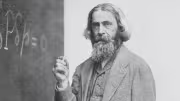
At an exhibition of his drawings and designs in 1904, he met schoolmistress Mary Haskell, who would be his lifelong friend, patron, and who knows what. In 1908 he went to Paris for two years of formal art study, supported financially by Haskell. He returned, found Boston provincial after Paree, and moved to New York City the next year. But before he went, he spent a morning with the 76-year-old, recently retired president of Harvard, as Paul M. Wright relates in “The President Meets the Prophet: Charles W. Eliot’s 1910 Encounter with Kahlil Gibran” (in the Harvard Library Bulletin, volume 21, number 3).
“I am making a series of drawings of the big men who represent the art and knowledge of this day,” Gibran wrote the president. He enclosed a letter of introduction from a cousin of Eliot’s to whom Haskell had introduced him. “I have already drawn Rodin, Debussy, Rochfort [sic] and others. Will you allow me the privilege of drawing you also?” Gibran asked for 30 minutes, but in the event spent a couple of hours talking with Eliot. The meeting was “delightful,” Haskell reported Gibran saying, but four years later the artist revised his opinion. “I realized he was cold & dead,” she quotes him in a journal devoted to Gibran, “and that I who had listened to him as to a big man, and admired him, was a little flame, a little bit of real life.”
Gibran warms Eliot up a touch in his drawing, published for the first time with Wright’s article. “The mouth seems a bit more sensuous than one might expect,” Wright judges, “the nose a bit more sculpted, and most notably, the neck and shoulder are depicted as bare rather than buttoned up in a high collar, cravat, and dark suit.”
Centennials: In 1912 the Titanic sank several Harvardians, Fenway Park opened (see “Fenway Park’s First Pitch”), and the Arnold Arboretum sprouted the Bulletin of Popular Information, later to grow into the estimable Arnoldia. Peter Del Tredici chronicles the periodical’s history in the current issue. Its original mission, its editor wrote, was to meet the complaints of people who “...do not know when the trees and shrubs in the Arboretum bloom and therefore miss flowers which they want to see.” To be safe, go at once.