
How did this story begin? Just after the Big Bang, the universe was “so smooth it was almost featureless,” as Charles Alcock describes it: an era when there was “no structure, no chemistry, no possibility of chemistry.” How then did it become the “heterogeneous” mix of planets, stars, galaxies, and filamentous structures organized across—and illuminating—space that astronomers study and interpret today? Alcock, professor of astronomy and director of the Harvard-Smithsonian Center for Astrophysics—and a member of the board of the Giant Magellan Telescope (GMT) organization—says scientists are “getting very close to being able to address extraordinarily challenging questions” about those conditions and processes. “Close, but not there.”
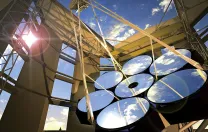
Next-generation Earth and orbiting telescopes, he says, should close the gap toward understanding the first stars and initial, small galaxies—created, according to current theories, when the universe was between a few hundred million and a billion years old. Perhaps half of the recently updated research objectives for the GMT concern queries about distant objects from the early universe. (The telescope will also enhance efforts to answer some of the same questions that rely on examining ancient stellar evidence from the Milky Way and its immediate environs; see “Stellar Archaeology,” page 41).
Among the subjects in which the GMT provides “a qualitative leap forward,” according to Baird professor of science Avi Loeb, a theoretical astrophysicist and chair of the astronomy department, is the formation of the first galaxies. His new book, The First Galaxies in the Universe, written with his former student, Steven R. Furlanetto, Ph.D. ’03, now an associate professor of physics and astronomy at UCLA, is a graduate-level overview of the theories underpinning the so-called “cosmic dawn,” when the universe was initially lit. (For a less quantitative version, see Loeb’s How Did the First Stars and Galaxies Form?—published in 2010 and the text for his similarly titled Freshman Seminar this spring semester.) As the introduction notes, it is timely because “the next decade or two will bring about a new generation of large telescopes with unprecedented sensitivity that promise to supply a flood of data about the infant universe during its first billion years after the Big Bang,” setting up the ideal test of that theoretical work and perhaps even revealing “new physics that has not yet been anticipated.”
The galaxies in question were smaller and intrinsically fainter than familiar ones like the Milky Way, and are being sought at enormous distances. All these features compound the problems of observation: how to distinguish a relatively dim nearby object from a much brighter one much farther away, for example, and to determine their actual distances? With a bigger telescope, Loeb says, “You get better data” and can collect it more productively, in shorter observation runs. Put simply: “You need a large light bucket to collect photons from very faint sources.”
As Loeb and Furlanetto write, Earth observatories like the GMT and the James Webb Space Telescope (now scheduled to launch late this decade, about the time when the GMT may begin operating) should together enable imaging and surveying of a “large sample of early galaxies” as well as studying their spectra “in detail”—essential for analyzing the chemistry and energies at play when the universe began to assume its recognizable aspects. The path to the astronomical and astrophysical frontiers thus passes along the course of designing, engineering, and building tools like the GMT and its associated spectrographs and imagers.