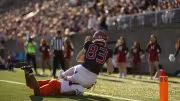
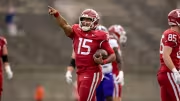
Among many other accomplishments, John T. Bethell, this magazine’s editor from 1966 through 1994, covered a lot of Harvard football games. He began writing, beautifully, about the sport he loves, in the Harvard Alumni Bulletin of September 20, 1971, reporting on new coach Joe Restic’s first day of practice. That dispatch appeared above Bethell’s initials. But for the October 11 issue, he adopted “Cleat,” the nom de football used by an earlier editor, Bill Bentinck-Smith, who may have thought it up. Bethell says undergraduates had long confected the Bulletin’s football columns; lacking a suitable candidate, he assumed the task “temporarily.” Now, he is hanging up his cleats.
It has been a remarkable run. Readers have come to rely on the archetypal “Cleat” dispatch, full of the historical resonances and records—long thought invincible, only to be overcome—that make college athletics such vivid fun. Of late, “Cleat” has upped his game, filing weekly online reports, e-mailed to registered readers. “I think I’ve seen all but two or three home games over the past 43 seasons,” Bethell recalls. “Haven’t traveled to Ithaca since the early 1970s, and had to skip a few other road games.” But only last September, beginning what became his final season, “Cleat” was there when the Crimson opened their campaign at the University of San Diego. His final dispatch, “Over the Moon” (January-February, page 34), taking in a 34-7 win in The Game, concludes on this characteristic note:
Harvard’s seven-game winning streak eclipses what had been the longest streak in the H-Y series, a string of six shutouts posted by Yale from 1902 to 1907. How long will the current streak last? “Statistically, this is unsustainable,” said coach Murphy at his postgame news conference. “Yale is coming back.” Time will tell.
But Bethell/“Cleat” won’t do the telling. Happily, however, the magazine’s tradition of rich, nuanced football coverage continues, in the capable hands of Dick Friedman ’73, who spent two decades as an editor and writer at Sports Illustrated. One of his most enjoyable tasks was helping edit SI’s The College Football Book (2008), for which he could call on more than a half-century of watching Crimson football. Friedman saw his first Harvard game at the Stadium at age seven, in 1958. Harvard lost to Penn, 19-6. “I was too young to know it, of course,” he says, “but that first chilly plunge readied me for a lifetime of disappointments and triumphs.”
His forthcoming history of the golden age of Harvard football, Crimson Autumns: When Harvard Was Number One, chronicles the 1908-1915 teams coached by the brilliant, innovative Percy Duncan Haughton, A.B. 1899, who “would be thrilled by the brainy play of current coach Tim Murphy’s teams.” Look for Friedman’s dispatches, continuing the “Cleat” tradition, online after games and in print throughout the season.