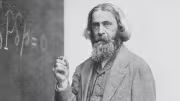
“Cal Watkins started out as a prodigy and always remained one. After finding that he liked Latin and Greek in school, he decided at 15 to become an Indo-Europeanist, delving into Sanskrit, Avestan, Hittite, Old Irish, and the other early languages of the Indo-European family. It was an unusual turn for an American teenager, but languages came easily to Cal.” The Thomas professor of linguistics and the classics emeritus, Calvert W. Watkins died in Los Angeles in March 2013, a week after his eightieth birthday. At the time of his death he was Distinguished Professor in residence at UCLA, where he continued his scholarly career after retiring from Harvard in 2003. Four of his former Harvard colleagues wrote a “memorial minute” about him that was entered into the records of the Faculty of Arts and Sciences last November and is quoted from here. They tell this tale about him: “Once, when he changed schools and had to catch up in French, the transition was smoothed by his being taken to see French movies, making sure he always got seated behind a lady in a fancy hat so he would be unable to see the subtitles.”
“As a Harvard undergraduate,” they wrote, “he concentrated in linguistics and the classics, graduating summa cum laude in 1954 with a thesis on a dialect of ancient Gaulish. His graduate career, likewise at Harvard, was spent partly in the Society of Fellows and partly abroad in Paris, Dublin, and Cracow. He received his Ph.D. in linguistics in 1959 and, after an accelerated rise through the junior ranks, found himself, at the age of 29, associate professor of linguistics and the classics. This made him, a year later, chairman and the only tenured member of the Department of Linguistics.”
Primus met Watkins in the Sixties, when everyone was young. At that time the prodigy was lining out brilliant books on the history of the Celtic verb and such things. “Not much of this output is accessible to a general audience,” wrote his faculty chroniclers. Indeed, Primus remembers nosily thumbing through the manuscript of a book Watkins was working on that seemed to consist entirely of the endings of mysterious words. When asked how many people on the planet Watkins was writing for, he thought for a moment and said, “Perhaps nine.” He reached a far wider audience with contributions to the American Heritage Dictionary. His magnum opus was How to Kill a Dragon in Indo-European: Aspects of Indo-European Poetics, which won the Goodwin Prize from the American Philological Association. He was an inspirational teacher. Today his students, and the students of his students, are said to dominate every aspect of Indo-European studies in the United States.
“Outside the classroom too, Cal was larger than life….His love of good times—good food, good drink, good friends—was legendary,” his colleagues attested. An amateur mycologist, Watkins would disappear each May to unspecified precincts in Vermont to find morels. An excellent cook, he once laid on a multi-dish dinner for trusting friends consisting entirely of various wild mushrooms he had foraged. He had Texas roots and a hint of a Texas drawl. His sense of humor led him frequently to crack up. Back in the day, Mrs. Primus thought he was the best dirty dancer she knew.