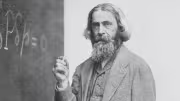
Faculty of Arts and Sciences memorial minutes recall how departed colleagues loomed large—but few, perhaps, in quite the same way as social psychologist J. Richard Hackman, who untangled how teams of people (orchestras, cockpit crews) work together. “Hackman was a towering figure not only intellectually, but quite literally,” the minute, presented at the February 6 FAS meeting, noted. “His 6' 6'' frame made him the favorite academic coach of Harvard’s women’s basketball team, generations of which invited him to sit on their bench.”
Much is gained in the shift from physical to digital records, but some things are lost, too—witness this note from Penelope Laurans, Ph.D. ’75, recently retired head of Yale’s Jonathan Edwards College:
“My late husband, Robert Fitzgerald, graduated from Harvard in 1933 and became Boylston professor in 1967. In his class were two others who became Harvard professors: Harry Levin, Babbitt professor of comparative literature, and Henry Hatfield, Francke professor of German art and culture. Soon after he arrived back at Harvard in 1968, he taught a course that was assigned to Sever and to a dusty room with clanking radiators that he remembered as unchanged from his College days. Before class started, he idly opened a drawer in the desk at the front of the room. Inside he found the class list—from a Latin B class that he, as well as Levin and Hatfield, had all taken in 1929. In nearly 40 years, no one had removed the list from the drawer!”
Hard on the heels of his obituary of Amey Amory DeFriez ’49 (The College Pump, May-June, page 80), The Boston Globe’s Bryan Marquard captured another feminist icon from that era. Joan Braverman Pinck ’50, RF ’69, who died in March, was for a time an assistant dean and lecturer at the Business School. Scholars there nowadays have plumbed reasons for distinguished women’s career difficulties; Pinck appears to have nailed it in a 1975 speech, according to the Globe excerpt: “Most women who work, married or not, live two lives, one professional and one domestic.” Many women who sought management roles, she added, “having been denied access by the front door, have learned how to shinny up the tree, climb on the roof, find their way through the attic to the back rooms in order to end up in the front office. And all the while keeping their hair combed, their clothes neat and appropriate, and bearing in mind that at the end of the day they were obliged to stop by the market to pick up the components of a meal which they themselves would prepare and serve, and that before starting out on their day’s work they had to be sure the cat was out, the dog in, the check left for the milkman, the laundry arranged for, and the car inspected.”
It is not unknown for aging sports heroes, say, to pick up some needed cash by auctioning off a game ball or World Series ring. The Christie’s sale of The Collection of Peggy and David Rockefeller [’36, G ’37, LL.D. ’69] in May differed in intent (proceeds benefit charities and institutions including MoMA and alma mater) and character (few athletes own Ming bowls), but the auctioneer did note that items on offer included Harvard cufflinks and a silver ashtray honoring David Rockefeller’s service as an Overseer.
Speaking of alma maters, the new version of “Fair Harvard” was rolled out (and sung out) at this Commencement. The contest previously described in this department (“‘Puritans’ Passé?” July-August 2017, page 68) has resulted in a last-line switcheroo (after “Let not moss-covered Error moor thee at its side,/As the world on Truth’s current glides by,/Be the herald of Light, and the bearer of Love,”) from “Till the stock of the Puritans die” to “Till the stars in the firmament die.”
That solution was successfully advanced by Janet Pascal ’84. It happily suggests, if biologists and astrophysicists are right about their respective realms, that the University’s life expectancy is a few billion years longer than previously forecast.