In 1994, Kendric T. Packer ’48 wrote to The Pump’s Primus IV to propose rendering the first line of alma mater “Fair Harvard” gender-neutral. (“Fair Harvard! thy sons to thy Jubilee throng” was the troublesome text.) In April 1997, Faculty of Arts and Sciences dean Jeremy R. Knowles announced a celebration of the role of women at the College, and Packer turned to him. After due consultation, a version forwarded to and tweaked by Packer (“Fair Harvard! we join in thy Jubilee throng”) became the approved one. With that, Knowles said, “[W]e have moved to a decent inclusiveness for the next 361 years.”
Not so fast. On April 5, President Drew Faust’s Task Force on Inclusion and Belonging homed in on the last line (“Till the stock of the Puritans die”) and declared, “We think it’s time for a change.” The full bureaucratic force of the University is on board: the website (https://inclusionandbelongingtaskforce.harvard.edu) has a “Revise the Alma Mater” tab complete with explanation of the competition for new wording, deadlines and timetable, FAQs, and a panel of judges (three faculty members, two culturally savvy alumni). A winner is to be announced next spring.
Beyond to-be-expected media censure for political correctness, the proposal has engendered some of the same from alumni. The Puritan community has not yet weighed in.
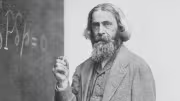
An article in this issue discusses the liberal arts. A memorial minute presented recently to the Faculty of Arts and Sciences, on Svetlana Boym, the late Reisinger professor of Slavic languages and literatures and of comparative literature, alluded to a different education model. “In Soviet Leningrad,” it noted, “she early on showed signs of…independence, once refusing to disassemble and clean an AK-47, a required part of her school program.” She emigrated in her late teens, leaving “without her parents, Yuri and Musa Goldberg, engineers whose application to emigrate would continue to be denied for nearly another decade (a young KGB officer named Vladimir Putin told them they would never see their daughter again).”
Harvard’s ever-evolving campus sometimes seems at risk of too-intensive development. The Kennedy School, for instance, is building more facilities underneath, within, and around its central courtyard. Bits of land, like the plot south of Malkin Athletic Center, have been nibbled away by (admittedly lushly landscaped) parking spaces.
But splendid pockets of greenery remain, awaiting visitors during the clement months. The walled courtyard at Busch Hall, complete with pond, is a lunchtime favorite. The courtyard bounded by the Converse, Naito, Bauer, and Fairchild laboratories should be on the calendar for next spring, when the redbuds, now mature, blossom; their leaves, clear yellow in autumn, merit a visit sooner. The redone Science Center courtyard, formerly an al fresco extension of the Greenhouse Café, is now mostly for viewing: a pleasing mini landscape of sedum-covered hillocks and a few sentinel pines—visual relief from the surrounding built bulk. Across the Charles, the new terrace behind Harvard Business School’s Chao Center, in a reimagined quadrangle of executive-education facilities, is growing in beautifully.
The Radcliffe Institute’s garden (shown above), comfortingly surrounded by brick walls to shut out Garden Street traffic noise, remains the best refuge; it always rewards a walk. As now replanted with ferns, its appeal extends from early irises through fall.
Another memorial minute, on John Max Rosenfield, Rockefeller professor of East Asian art emeritus, looked at his journey to fine-art scholarship: “In high school he showed an aptitude for painting, although later he would speak disparagingly of his own efforts, referring to his canvases as ‘regionalist landscapes with cacti and an occasional jackrabbit.’”