Headlines from Harvard’s history

Headlines from Harvard’s history

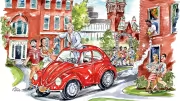
Illustration showing how Harvard Business School settled on its new name in 1961

Illustration by Mark Steele

1921

Barracks and stables are under construction on Soldiers Field to house 20 enlisted men and 85 horses for the department of military science.

1946

As of October 1, a total of 12,183 students have registered for fall term—a third larger than the previous peak—with final business and law school figures yet to come. Housing, especially for the 3,300 married veterans, is a major problem. Among the 5,419 undergraduates, there are 3,858 veterans.

1951

The weekly board fee for undergraduates reaches $14, prompting talks of limiting servings in the dining halls.

1956

Martha May Eliot’s appointment as professor and head of the department of maternal and child health in the Faculty of Public Health makes her Harvard’s third female full professor.

1961

Among alterations proposed for the Harvard School of Business Administration after a two-year study initiated by its dean is a change of name. The Bulletin reports “a widespread feeling” that the present name “does not imply an institution of professional stature, and that there should be…a Harvard Business School.”

1966

Creation of the Institute of Politics—at the renamed John F. Kennedy School of Government—is officially announced at a dinner on October 17, held in the newly completed Holyoke Center and attended by eight members of the Kennedy family.

1971

The Harvard class of ’75 includes the sons of the presidents of Columbia and Yale.

2006

The new Harvard College Women’s Center opens in Canaday Hall, culminating “the efforts of our students for 35 years,” notes dean of the College Benedict Gross. People “had to be pushy as well as smart to make this happen,” adds 300th Anniversary University Professor Laurel Thatcher Ulrich.
 

You might also like

250 Years Ago, Harvard Was Home to a Revolution

A look at the sights, sounds, and characters that put the University on the frontlines of history

The Woman Who Penned the Case for War

Mercy Otis Warren’s poetry and plays incited the Patriot movement.

How the American Revolution Freed a Future Abolitionist

Darby Vassall, an enslaved child freed after the Battle of Bunker Hill, dedicated his life to fighting for liberty.

Most popular

Martin Nowak Placed on Leave a Second Time

Further links to Jeffrey Epstein surface in newly released files.

Harvard study: termite mounds circulate air, sneezing once a day

Physicists look into the function of towering termite mounds.

Harvard Law Professor Explains the AI Battle Between Tech and Government

Jonathan Zittrain compares today’s conflicts to tensions surrounding the early internet.

Explore More From Current Issue

Mercy Otis Warren in period attire writes at a desk by candlelight, surrounded by books.

The Woman Who Penned the Case for War

Mercy Otis Warren’s poetry and plays incited the Patriot movement.

A dancer in a black leotard poses gracefully in a bright studio, with mirrors reflecting her movement.

A New ‘Black Swan’ Musical Cranks Up the Tension

The creative team of the A.R.T.’s new show dish on adapting Darren Aronofsky’s thriller classic from screen to stage.

A woman with long hair leans on a table, looking out a large window with rain-streaked glass.

A Harvard Economist Probes the Affordable Housing Crisis

From understanding gender pay gaps to the housing crisis, Rebecca Diamond’s research aims to improve lives.