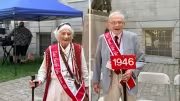
As noted elsewhere in this issue, 2022 will go down in Harvard annals as the year the institution broke a long tradition and altered the format of Commencement Day. Graduation exercises will continue to take place on a Thursday in late May, but the afternoon meeting of the Harvard Alumni Association (HAA), and all reunion activities, have been shifted to the first week in June. The principal address of the day, formerly a high point of the afternoon meeting, will now conclude the morning exercises, making it more of a standard graduation speech. And in another innovation, the HAA has rebranded its annual meeting as Harvard Alumni Day.
University officers say the morning and afternoon exercises were decoupled to relieve overcrowding in the Tercentenary Theatre. The available seating capacity of that space—the quadrangle between Widener Library and the Memorial Church, the rostrum on the church steps, and fringe areas of the Yard—is 32,000. The potential audience for Commencement has grown to include more than 8,000 degree candidates, 20,000 family members and guests, and up to 10,000 alumni attending class reunions. In round numbers, that adds to 38,000, and counting. The remedial measure of choice was to outplace the alumni.
Because alumni have gathered at Commencement since the College’s first days, overcrowding has been a perennial problem. The earliest exercises, with a banquet to follow, were held in the original Harvard Hall, with room for about 60 people. These events moved in the eighteenth century to the larger Old Meeting House, but it was not large enough. A contemporary account of the 1735 festivities depicts a hall “so prodigiously crowded, that the galleries were in danger of falling; and several persons were so apprehensive of their Danger, that they jumped out of the Windows, and others with great Difficulty got out thro’ the Doors.”
One hall after another was tried and found wanting. At the founding of the Alumni Association, in 1841, members created a fund to pay for a meeting hall for use on “anniversaries and Commencement-Days.” That goal was fulfilled in 1876, when Memorial Hall and its 1,200-seat Sanders Theatre were finished. But a generation later, College officials were seeking alternative sites.
An obvious—and capacious—one was Harvard Stadium. It was used in 1916, with a record audience of 10,000 housed in the bowl end. The Alumni Bulletin hailed the change of venue as “a notable forward step…satisfying both to eye and ear.” Yet the following year, with the nation at war and many degree candidates already on military duty, the exercises returned to Sanders.
Rankled by a policy that limited them to a single guest ticket, seniors in the class of 1922 petitioned to graduate in a facility larger than Sanders. That prompted a move to the Sever Hall quadrangle, which since 1911 had been the locus of the Alumni Association’s afternoon meeting. Seating about 3,500, Sever Quad remained the site of Commencement until 1946, when returning veterans swelled enrollments and the exercises moved to the Tercentenary Theatre.
Outdoor events run the risk of rain. The 1922 exercises, reported the Bulletin, had been “an oasis of dryness in the wettest Commencement Day and season of recent years.” Miraculously, a 45-year streak of fair weather ensued, and “It never rains on Harvard Commencement” became a well-worn saying. Only in 1968 did precipitation force a retreat to Sanders, shrinking the in-person audience from 12,000 to 1,200.
Since then, rain has dampened the morning exercises five times, according to a tally by John T. Bethell ’54, this magazine’s previous editor. Writing in Happy Days, an anthology of Commencement reflections issued last year by the HAA, he noted that on each occasion, administrators had made a game-time decision to tough it out. “Rain or shine,” he wrote, “the principals in the ritual—the degree candidates, the academics conducting the ceremony, the friends and family in the audience—are all in it together. And if it’s rain and not shine, all are bonded by a spirit of willing endurance. For new graduates and witnesses alike, Commencement is a life-affirming rite of passage, and one that rainfall cannot quench.”