Headlines from Harvard’s history

Headlines from Harvard’s history

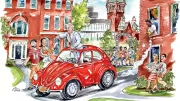
Humorous illustration of campus police seeing late-night daters’ final kiss

Illustration by Mark Steele

1927

“To vagabond,” i.e., “to rove around classrooms where one does not belong,” has entered the undergraduate vernacular. The Bulletin reports a noticeable increase in the practice during the fall, as Crimson editors have begun printing daily lists of lectures deemed to be of general interest.

1932

Memorial Church, built in honor of the Harvard dead of “the World War,” is dedicated on the morning of Armistice Day.

1942

Gasoline shortages translate to a higher bike-theft rate, causing the City of Cambridge to mandate bicycle registration and licensing to make apprehending two-wheel thieves easier.

1982

Though MIT pranksters disrupt The Game with an inflatable “bomb” that erupts from the earth in front of the Crimson bench to blow up in a cloud of gray smoke, Harvard wins 45-7.

1987

Sally H. Zeckhauser becomes the first woman to serve as a Harvard vice president. The new administrative VP previously spent eight years as president and CEO of Harvard Real Estate Inc.

1992

The Faculty of Arts and Sciences approves a new undergraduate concentration in environmental science and public policy that will require students to study fields as diverse as chemistry and economics in a “broad integration of science and policy.”

Harvard has “locked the doors and [thrown] away the keys” for the Yard dorms, the editors report. The installation of card-reading devices and distribution of magnetic plastic cards to the freshmen will likely be extended to the Houses to crack down on crime, despite occasional glitches—a door held open too long for a good-night kiss summons a University police car to investigate.
Related topics

You might also like

250 Years Ago, Harvard Was Home to a Revolution

A look at the sights, sounds, and characters that put the University on the frontlines of history

How the American Revolution Freed a Future Abolitionist

Darby Vassall, an enslaved child freed after the Battle of Bunker Hill, dedicated his life to fighting for liberty.

The Costly Choice Native Americans Faced

How the Revolution reshaped indigenous New England

Most popular

Harvard Law Professor Explains the AI Battle Between Tech and Government

Jonathan Zittrain compares today’s conflicts to tensions surrounding the early internet.

At Harvard, Mitt Romney Warns Against ‘Authoritarian’ Presidential Power

The former senator touched on polarization, tech governance, and diplomacy during a conversation at the Institute of Politics.

Martin Nowak Placed on Leave a Second Time

Further links to Jeffrey Epstein surface in newly released files.

Explore More From Current Issue

A dancer in a black leotard poses gracefully in a bright studio, with mirrors reflecting her movement.

A New “Black Swan” Musical Cranks Up the Tension

The creative team of the A.R.T.’s new show dish on adapting Darren Aronofsky’s thriller classic from screen to stage.

Mercy Otis Warren in period attire writes at a desk by candlelight, surrounded by books.

The Woman Who Penned the Case for War

Mercy Otis Warren’s poetry and plays incited the Patriot movement.

A man holding a revolver and lantern, wearing a hat and coat, appears to be walking cautiously.

Scoundrels, Then and Now

On con men, Mark Twain, and the powers of the Harvard name