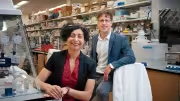
Mary Ellen Avery, S.D. ’05, Rotch professor of pediatrics emerita, an innovative medical researcher and role model who “shattered each glass ceiling she encountered,” according to the Boston Globe, died on December 4 at the age of 84. In 1974, she became the first woman to chair a major department at Harvard Medical School as well as the first woman named physician-in-chief at Children’s Hospital Boston. She received the National Medal of Science in 1991, and the Howland Award of the American Pediatric Society, her field’s highest honor, in 2005.
In the late 1950s, while a research fellow at Harvard, Avery and physiology professor Jeremiah Mead discovered the key factor in hyaline membrane disease—the absence of a critical surfactant, a foamy coating that helps the lungs expand—in premature babies who died soon after birth because they couldn’t reinflate their lungs after exhaling. In a conversation with journalist and photographer Georgia Litwack, published in this magazine’s September-October 1977 issue, Avery called this breakthrough in combating respiratory distress syndrome “the single scientific contribution of mine which will live on. There were many, many other clarifications of the problem—variations and modifications—that extended the story. But there was one moment of insight. And that was it.”
“She was a scientist who made a major, major discovery,’’ Berenberg Distinguished Professor of pediatrics Frederick Lovejoy Jr., associate physician in chief at Children’s Hospital, told the Globe. “It didn’t ultimately result in the Nobel Prize, but it was of that stature. And she was an absolute pioneer for women in medicine.’’
Georgia Litwack’s feature article, “Times are changing. The public expects communication with the physician,” covering Dr. Avery’s reflections on the practice and teaching of medicine and on women in medicine, is available as a PDF from the Harvard Magazine archives. (Avery and Litwack later collaborated on the book Born Early: The Story of a Premature Baby.)
A memorial service for Dr. Avery will take place at 10 a.m. on February 4 in Folkman Auditorium at Children’s Hospital.