The Age of Science: What Scientists Learned in the Twentieth Century, by Gerard Piel '37 (Basic Books, $40). The founder of Scientific American offers an elegantly written, accessible, panoramic, and hopeful account of "what I have learned about what scientists learned in the 20th century, in sum: The work of science is converging on seamless comprehension of the world around us and the identity of ourselves in it."
The Future of Life, by Edward O. Wilson, Ph.D. '55, Jf '56, Pellegrino University Research Professor (Knopf, $22). "An Armageddon is approaching at the beginning of the third millennium...," writes Wilson. "It is the wreckage of the planet by an exuberantly plentiful and ingenious humanity. The race is now on between the technoscientific and scientific forces that are destroying the living environment and those that can be harnessed to save it....If the race is won, humanity can emerge in far better condition than when it entered, and with most of the diversity of life still intact."
Poetry Speaks: Hear Great Poets Read Their Work from Tennyson to Plath, edited by Elise Paschen '81 and Rebekah Presson Mosby (Sourcebooks, $49.95). An anthology of work by 42 poets, with three audio CDs on which each reads. Dylan Thomas reading "Do Not Go Gentle into That Good Night" alone is worth the price of admission.
America's Children, by James Thackara '67 (Overlook Press, $26.95). Thackara is an American working in London. His vast World War II novel, The Book of Kings, appeared in a U.S. edition in 1999, and now his first novel is published here. It concerns J. Robert Oppenheimer and how it happened that we created the means of our potential annihilation.
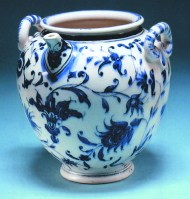 | Bazaar to Piazza: Islamic Trade and Italian Art, 1300-1600, by Rosamond E. Mack, Ph.D. '72 (University of California Press, $65). Independent scholar Mack shows how art objects imported from Asia profoundly influenced Italian decorative arts. She writes of silks, paintings, carpets, ceramics, glass, bookbindings, and inlaid brass, and supports her interesting text with a profusion of illustrations of objects from many collections, excellently reproduced. |
| Medici grand dukes epitomized Italian fascination with exotic ceramics. This soft-paste porcelain flask from a palace workshop in Florence, circa 1574 to 1587, adopts a motif from Turkish ceramics of the day--scrolls of peony blossoms. From the book and the National Gallery of Art, Washington, D.C. | |
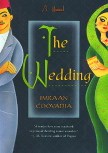
The Wedding, by Imraan Coovadia '92 (Picador, $23). Ismet Nassim, a shambling clerk of modest prospects from Bombay, looks out the window of a train and sees on the station platform the most beautiful woman in the world. He marries her next day despite her vow neither to love nor obey him. Their comic misalliance is deftly chronicled by Coovadia, who bases his novel on family stories he heard growing up.
The Paradox of American Power: Why the World's Only Superpower Can't Go It Alone, by Joseph S. Nye Jr., Ph.D. '64, dean of the Kennedy School of Government (Oxford University Press, $26). Nye warns about a foreign policy that combines "unilateralism, arrogance, and parochialism" and argues for a broader, more cooperative, and more responsible engagement with the rest of the world.
First Fruit: The Creation of the Flavr Savr Tomato and the Birth of Biotech Food, by Belinda Martineau '80 (McGraw-Hill, $24.95). Here's an insider's story of the rise and demise of the first genetically engineered whole food ever brought to market--by Calgene, a California biotech start-up, in 1994--a "slow-to-rot" tomato with some genes that had been effectively switched off.
Venice Forever: A History of the Serene Republic for Travelers, by John D. Irany, M.P.A. '86 (Clipper Ship Publishing, $19.95, paper). Visitors to Venice cannot fail to be seduced by it, writes Irany, and, strolling across the Piazza San Marco, captivation will be complete if one knows the history of the beautiful, vital Serenissima Repubblica. Nonstrollers may welcome this book as well.
The Tangled Wing: Biological Constraints on the Human Spirit, by Melvin Konner, Ph.D. '73, M.D. '84 (Times Books, $35). A revised edition of a seminal work published 20 years ago, since when lots has been learned about why we act and feel the way we do.
The Encyclopedia of World History, Peter N. Sterns '57, Ph.D. '63, general editor (Houghton Mifflin, $59.95). This sixth edition of a reference classic, first edited by Harvard professor William L. Langer and last updated 30 years ago, comes with a CD-ROM (PC-compatible only) containing the entire text, allowing the user to search by keyword.