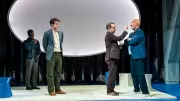
How to explain evolution? To honor the sesquicentennial of the publication of On the Origin of Species, the National Institutes of Health commissioned Catalyst Collaborative@MIT to create a new play that would “help audiences feel the profound impact that Darwin’s work has had in our lives and across scientific disciplines,” explains artistic director Debra Wise. The result, award-winning playwright Melinda Lopez’s From Orchids to Octopi: An Evolutionary Love Story, is now celebrating its world premiere in Cambridge; the Boston Globe review called it “a remarkable demonstration of the strength that art and science can find when they work together to enlighten our minds and touch our souls. If you’ve ever wondered what playwrights and biologists could possibly have in common, here’s the missing link.”
The lively performance presents not only Charles and Emma Darwin, a pregnant mural painter, and a carnival barker, but also 375-million-year-old Tiktaalik roseae and a parka-clad, snow-goggled, rifle-toting actor portraying Farish Jenkins—one of the discoverers of that “fishapod” on Ellesmere Island in Nunavut, Canada. Jenkins is professor of biology and curator of vertebrate paleontology, Alexander Agassiz professor of zoology in the Museum of Comparative Zoology, and professor of anatomy in the Harvard-MIT Division of Health Sciences and Technology; like Darwin before him, he has traveled to out-of-the-way places, and his work, in turn, has provided dramatic support for Darwin’s original insight.
Behind the scenes, meanwhile, many of Jenkins’s colleagues also played a role in the origins of Lopez’s script. Those interviewed in depth, as listed in the program notes, include Strong professor of infectious diseases Dyann Wirth and assistant professors Pardis Sabeti and Christopher Marx, from the department of organismic and evolutionary biology. Also consulted were professor of epidemiology Marc Lipsitch and Eric Lander, director of the Broad Institute. In addition, University affiliates have presented short pre-performance symposia and post-performance talkbacks during the play’s run. Among those still scheduled to appear are Lipsitch (April 23), Loeb associate professor of biology and curator of mammals Hopi Hoekstra (April 24), lecturer on studies of women, gender, and sexuality Linda Ellison and lecturer on human evolutionary biology Zarin Machanda (May 1), and professor of biology and Agassiz professor of zoology in the Museum of Comparative Zoology emeritus Richard Lewontin (May 1). Happily joining these scientists in bringing the play to fruition were two alumni artists: dramaturge, research assistant, and puppeteer Roxanna Myhrum ’05, who "spent many late nights reading Darwin’s letters and fact-checking dialogue for two-headed cows," and set designer and mural painter David Fichter ’73, whose mural-covered periaktoi, declared the Globe reviewer, “spin and slide and whirl…to resolve at the very end into a dazzlingly coherent, dizzyingly various, and deliriously lovely painting of life in all its complexity.”
A detailed performance schedule is available online.