Act I: John Weidman ’68 spends the first 13 years of his life in Westport, Connecticut, where he plays Little League baseball and dreams of turning pro. Then he realizes: “There are no major league players from Westport.” His revised attitude about the future: “Wait and see.”
Act II, Scene 1: Weidman (wide-man) at Harvard. His father is a writer (the novelist and dramatist Jerome Weidman, author of I Can Get It for You Wholesale), so it’s only natural that he befriends Timothy Crouse ’68, the son of playwright Russel Crouse, who coauthored the book for The Sound of Music. In 1966, on a lark, they write the Hasty Pudding show A Hit and a Myth. (“Nothing seemed at stake. And we got to go to Bermuda.”)
Act II, Scene 2: Weidman graduates. He extends his “Wait and see” credo by applying to law school. Facing the draft, he chooses not to attend Yale immediately, and instead teaches for a few years at a New York public school. Then he heads to New Haven to join Clarence Thomas in the Yale Law class of 1974.
Certain that the law is not for him, Weidman writes two letters, seeking an internship. The first goes to Bowie Kuhn, commissioner of Major League Baseball, who blows him off. The second--with a postscript: “I have an idea for a play about the opening of Japan; can we talk about it?”--goes to Broadway producer-director Hal Prince. Weidman: “At Harvard, I majored in East Asian history--I thought I knew something no one else did. I had no ambition to write a play. I had no training. I just thought: I can do this while I’m at Yale.”
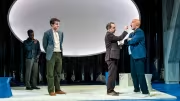
Act II, Scene 3: Prince meets with Weidman for 15 minutes before giving him a contract (and $500) to write the play. In the summer of 1973, Weidman completes a draft of Pacific Overtures. Prince decides it needs to be a musical--and convinces Stephen Sondheim to turn the play into one. Weidman: “It was so surreal I didn’t stop--at least not too often--to think that I was working with two giants of the theater.” Pacific Overtures opens in 1976. Reviews are mixed. But the marquee says it all: Prince. Sondheim. Weidman.
Act III, Scene 1: Weidman writes for the National Lampoon, which leads to several years of screenwriting. In 1978, he marries a Yale classmate, Lila Coleburn, who soon abandons law herself for clinical psychology. Two children follow. Watching Sesame Street with his daughter, he decides that working there would be honest labor, and he begins to write sketches for the show.
Act III, Scene 2: In the mid 1980s, Anna Crouse, Russel’s widow, decides that the reason there has been no first-class production of her late husband’s Anything Goes since 1934 is that the book isn’t good enough. (Howard Lindsay and Crouse rewrote the P.G. Wodehouse/Guy Bolton book for the Cole Porter musical.) For $1,000 each, she hires Weidman and her son to rewrite it. Despite a mixed review in the New York Times from Frank Rich ’71 (“The corny, sporadically amusing one-liners…give the script the collegiate air of a Harvard Hasty Pudding show”), the show is a hit and runs for two years.
Act III, Scene 3: Along the way, Weidman and Sondheim become friends. Periodically, they meet to kick around ideas. In the late ’80s, Sondheim mentions his interest in the men who have tried to kill a U.S. president. Weidman is equally intrigued; their collaboration becomes Assassins. Weidman: “I was a Camelot kid. After Kennedy was shot, I went to Washington and stood on the sidewalk as his cortege passed by. And I thought--as Steve did--how can one small man cause so much grief? We opened at Playwrights Horizons and were mostly vilified, but I’ve never enjoyed anything as much as working with Steve on that.”
Sondheim: “Ordinarily, I start reading the librettist’s work after he has written one or two scenes, but John never offered to show them to me. I assumed that his reluctance to show me anything came from uncertainty. I should have known better from the man who wrote Pacific Overtures. Within five minutes of reading, I knew the reason for John’s hesitation in showing me what he was writing: far from uncertainty, he knew exactly what he was doing, and he was on a white-hot roll.”
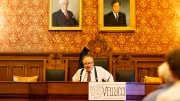
Act III, Scene 4: Assassins (1990) polarizes reviewers, as does Road Show (2008), his third collaboration with Sondheim. Other shows provoke no ambivalence. He is nominated for the Tony Award for best book for a musical three times (Pacific Overtures, Big, and Contact), and wins a 2000 Tony for the dance musical Contact. For his Sesame Street work, he wins a dozen Emmys. And, for a decade, he’s president of the Dramatists Guild. He is one of only three writers to have had several collaborations with the great Sondheim.
The Critic’s Turn: In March, Anything Goes will be revived on Broadway, with Joel Grey and Sutton Foster--in a theater named for Stephen Sondheim. Completes a circle, doesn’t it? Weidman shrugs it off; unlike many theater people, he seems to have no ego, no urgent drive, no need to be noticed. From his 2008 Harvard class report: “The success my career has afforded me, both psychic and material, has not been spectacular, but it has been substantial and, more importantly, enough for me.” Unspectacular? “That’s the first time I wrote intimately about myself--ever. And it’s not false modesty. That’s an entirely accurate description of how I feel.” Then what’s the payoff? “I like writing dialogue. I like the solitary part. I like collaborating. I just really enjoy the work.”