
Every spring, after the desiccating winds of winter, lush green grass sprouts in the Yard, reaching maturity just in time for Commencement—when throngs of jubilant students and proud parents promptly trample it again. Harvard Yard is a tough environment for plants of all kinds because it is so well loved and used. The team that tends this urban oasis on behalf of the institution and its barefoot summer scholars, its Frisbee players, and its casual passers-by works year-round to sustain the inviting plane of green that spreads beneath high-branching trees. Pictured in this February photograph, from left to right and front row to back, are foreman Art Libby, with Donald Ford and Ryan Sweeney; Ray Pacillo, Frank Lemos, and John Patti; Tiago Pereira, arborist Mark Muniz, and the crew’s supervisor, associate manager for grounds Paul Smith, who has been caring for Harvard Yard for 19 years. “Winters are tough,” Smith says, “but the other eight months are great.” Come spring, they work at a whirlwind pace, mulching and mowing, sweeping walks, fixing irrigation lines, pruning shrubs and trees. When Smith started at Harvard, it took tons of fertilizer to revive the Yard’s viridescent lawns each year. But today, he reports, the landscape is maintained organically: leaves and trimmings are raked and vacuumed up each fall, shredded and chipped, and later returned to the soil as “compost teas and humates.” Earthworms, once scarce, are now abundant (although the crew still needs to aerate). Smith confesses he would never have believed how much more natural activity there is underfoot. His crew likes “working to make the grounds of a worldwide institution look nice. Within a city, it’s a tough thing to do.”
Meet the men who tend Harvard Yard
Meet the men who tend the Yard.

Photograph by Jim Harrison
You might also like

They Might Be (Harvard) Giants
Two tales of University greats—and an encounter with a Tiger
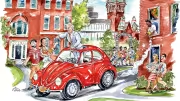
A Harvard President’s VW Beetle That Kept On Giving
Derek Bok donated his car for a good cause.

The Year a Beat Poet Squatted at Harvard
In 1954, Gregory Corso moved into Eliot House. How he stayed there is a literary legend.
Most popular



Explore More From Current Issue

For advocacy and benevolence, three late alumni are reportedly in line for the Catholic Church’s highest honor.

Can the College do more to prepare students for the real world?

Establishing legal responsibility for autonomous agents