1921
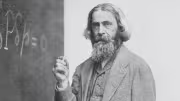
For the first time in 40 years, Harvard is planning a Chinese-language course, to be taught by philosophy instructor Yuen Ren Chao, Ph.D. ’18.
1931
A new rule on “the entertainment of women in Harvard Houses” requires written permission to be obtained from the House master or senior tutor 24 hours prior to the visit unless the guests are mothers or sisters.
1941
University librarians have completed plans to evacuate 100,000 rare volumes to a secret location if necessary in time of war.
1946
As part of a new experiment in General Education, President Conant delivers his first course lecture since taking office, speaking to undergraduates and the general public on the strategy and tactics of science and on the principles of chemistry.
1951
The presidents of Harvard, Yale, and Princeton issue a joint statement declaring that no athletic scholarships are given out by their institutions. “The athletic program,” they assert, “exists for the contribution it can make to [a] healthy educational experience, not for the glorification of the individual or the prestige or profit of the college.”
1956
Martha May Eliot resigns as chief of the U.S. Children’s Bureau to join the School of Public Health as head of the department of maternal and child health, becoming Harvard’s third female full professor.
1981
Fifteen junior-faculty professorships have been created thanks to a $7.5-million gift to the Harvard Campaign from John L. Loeb ’24.
1991
A special double issue of the conservative undergraduate magazine Peninsula focused on proving that “homosexuality is bad,” prompts a protest rally in response, during which Plummer professor of Christian morals Peter J. Gomes reveals, “I am a Christian who happens as well to be gay, and these realities which are unreconcilable to some are reconciled in me.”