A history of placekicking in football

For many decades, placekickers weren’t specialists

Return to main article:

In its early years, American football used a round ball that players would hold in their hands, drop to the ground, and kick on a low bounce. With the advent of the forward pass, the ball took on its current elliptical shape, making it easier to throw—but causing unpredictable bounces. So the drop kick gave way to placekicking, with tees (for kickoffs) and holders (for field goals and extra points).

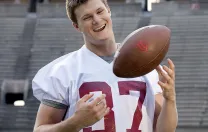
For many decades, placekickers weren’t specialists: position players moonlighted at the task. Gino Cappelletti of the Boston (now New England) Patriots, for example, was a wide receiver, and the legendary Lou “the Toe” Groza of the Cleveland Browns was an offensive tackle. Groza converted 88.5 percent of his attempts in 1953, at a time when most National Football League (NFL) teams missed more than half their field goals.

In the 1960s, accuracy rose markedly with the advent of “soccer-style” kicking, which a Budapest-born Cornell graduate, Pete Gogolak, brought to American football. He kicked for the Buffalo Bills and then the New York Giants (becoming their all-time leading scorer) from 1964 until 1974.

One of Lou Groza’s kicking shoes resides in the Smithsonian, but no NFL rule requires that kickers wear a shoe at all. Rich Karlis, who kicked mostly for the Denver Broncos, was the last of the barefoot placekickers; he ended his career with the Vikings and Lions, retiring in 1990.


Related topics

You might also like

How a Harvard Hockey Legend Became a Needlepoint Artist

Joe Bertagna’s retirement project recreates figures from Boston sports history.

Harvard Students, Alumni to Compete at the 2026 Olympics

Six Crimson athletes are headed to the XXV Winter Games in Milano Cortina. 

Introductions: Dan Cnossen

A conversation with the former Navy SEAL and gold-medal-winning Paralympic skier

Most popular

Harvard Professor Michael Sandel Wins Philosophy’s Berggruen Prize

The creator of the popular ‘Justice’ course receives a $1 million award.

Martin Nowak Placed on Leave a Second Time

Further links to Jeffrey Epstein surface in newly released files

The True Cost of Grade Inflation at Harvard

How an abundance of A’s created “the most stressed-out world of all.”

Explore More From Current Issue

A lively street scene at night with people in colorful costumes dancing joyfully.

Rabbi, Drag Queen, Film Star

Sabbath Queen, a new documentary, follows one man’s quest to make Judaism more expansive.

A close-up of a beetle on the textured surface of a cycad cone and cycad cones seen in infrared silhouette.

Research in Brief

Cutting-edge discoveries, distilled

Four Labrador puppies—two black and two yellow—sitting in green grass.

What Do Puppies Know?

Canine capabilities emerge early and continue into adulthood.