Final Steps on Final Clubs?
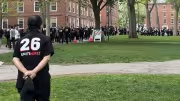
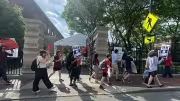
At the November 7 Faculty of Arts and Sciences (FAS) meeting, the faculty voted on a measure pertaining to final clubs, fraternities, and sororities (unrecognized single-gender social organizations, or USGSOs, that do not conform to the College’s requirements for recognized student groups and clubs: nondiscriminatory selection processes, open membership, and local governance).
BREAKING NEWS
At the Decmber 5 faculty meeting, President Faust announced that she and the Corporation have adopted the May 2016 social-club sanctions. For a preliminary report, see harvardmag.com/implementation-17; a full report will appear in the next issue of Harvard Magazine.
In response to the sanctions for USGSO student members unveiled in May 2016 by dean of Harvard College Rakesh Khurana, and a subsequent proposal that future students be prohibited outright from joining such organizations, Gordon McKay professor of computer science Harry Lewis and like-minded colleagues advanced a motion that would proscribe either measure. They cited students’ right of free association in legal activities, and objected both to features of the sanctions and to devolving decisions on policies governing student life—matters they argue are subject to faculty legislation—to administrators. When put to a vote, though, the motion went down, 130 to 90—with about 25 percent of eligible FAS members weighing in. An Undergraduate Council survey of students (not adjusted for the response rate) showed 61 percent opposed to the sanctions on USGSO members. A detailed report is available at harvardmag.com/fas-novmtg-2017.
What USGSO policies would finally be put in place, however, remained unresolved. The final report of a committee on the matter, co-chaired by Khurana, laid out three options, rather than settling on one: the sanctions regime (effective for the freshmen who enrolled this year, but not being implemented while deliberations continue); the prohibition on membership (which would presumably take effect for freshmen enrolling next August); or some third course of action, possibly relying on education and suasion, intended to make participating in gender-exclusive social clubs unattractive. For a discussion, see harvardmag.com/fasfractures-17.
Preventing Preprofessionalism
At the same November FAS meeting, dean of undergraduate education Jay Harris introduced a proposal that would limit how many course credits undergraduates could take from other Harvard faculties, and have count toward the bachelor’s degree: eight out of 128. (Students would be free to take as many additional courses, uncredited, as they wished, and, as before, can still take an unlimited number of credits earned in courses offered by MIT.) There would be one exception to the eight-credit limit: any cross-registered courses that a department counts toward concentration credit would not count toward the new limit. This issue has risen in importance as barriers to cross-registration have fallen; from the fall of 2013 to last spring, the number of cross-registrations tripled, to nearly 300.
The rationale, explained in a handout, is straightforward: to safeguard “the integrity of the College’s liberal arts and sciences degree” by posting some boundaries around preprofessional education. The risk is spelled out, too: the concentrations with the largest numbers of cross-registrants are those most professionally oriented: economics, government, computer science, and social studies. And the most popular option for enrollment outside the College? The clearly preprofessional MIT course “Corporate Financial Accounting”—an obviously useful bit of learning for the (many) new graduates who still head off to Wall Street or consulting.
The proposal was adopted at the FAS meeting on December 5.