William Kaelin Wins Nobel Prize in Physiology or Medicine

Kaelin is the forty-ninth Harvard faculty member to win the Nobel. 

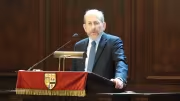
William G. Kaelin pictured in his home in Boston shortly after receiving the call from Sweden

William G. Kaelin

Photograph by Stephanie Mitchell/HPAC

William Kaelin, Farber professor of medicine, has won the Nobel Prize in physiology or medicine, the Nobel Foundation announced this morning. He shares the prize with Sir Peter J. Ratcliffe, of the University of Oxford, and Gregg Semenza ’78, of Johns Hopkins University, for their research on how cells adapt to changing oxygen levels. 

The team “discovered how cells can sense and adapt to changing oxygen availability. They identified molecular machinery that regulates the activity of genes in response to varying levels of oxygen,” according to an announcement from the Nobel Assembly at Karolinska Institutet. “The seminal discoveries by this year’s Nobel Laureates revealed the mechanism for one of life’s most essential adaptive processes. They established the basis for our understanding of how oxygen levels affect cellular metabolism and physiological function. Their discoveries have also paved the way for promising new strategies to fight anemia, cancer and many other diseases.”

Kaelin is the forty-ninth Harvard faculty member to win a Nobel Prize. His most recent predecessor, economics professor Oliver Hart won the 2016 Nobel Prize in economic sciences for his advances in contract theory.

Kaelin’s fellow winner Gregg L. Semenza ’78 is Armstrong professor of medicine at the Johns Hopkins University School of Medicine. A Hopkins press release notes that his research paves the way for the development of drugs that could kill cancer cells by cutting off the supply of oxygen a tumor needs to grow, and could also lead to medicines allowing tissues affected by conditions such as arterial disease to survive on low oxygen.
You might also like

NASA Astronaut Jonny Kim to Speak at Harvard in June

The American Navy SEAL, born to immigrants, is a doctor and a space traveler.

Chan School of Public Health Department Chair Departs for UCLA

Kari Nadeau, an environmental health leader, will serve as the dean of the Fielding School of Public Health.

Trump Administration Sues Harvard over Civil Rights

The March 20 suit seeks to rescind research grants that were restored in an earlier court ruling.

Most popular

Ken Burns on America’s Unfinished Revolution

At Radcliffe, the filmmaker joined Harvard historians to discuss what the nation’s founding means today.

Paul Ryan Warns Congress Is Losing Power—and Blames Both Parties

At Harvard Kennedy School, the former House speaker reflected on executive overreach, DEI, and “wokeism.”

Department of Education Investigates Harvard Admissions and Antisemitism Claims

The University calls federal actions “retaliatory.” 

Explore More From Current Issue

Four Labrador puppies—two black and two yellow—sitting in green grass.

What Do Puppies Know?

Canine capabilities emerge early and continue into adulthood.

Three climbers seated on a snowy summit, surrounded by clouds, appearing contemplative.

These Harvard Mountaineers Braved Denali’s Wall of Ice

John Graham’s Denali Diary documents a dangerous and historic climb.

A black primate hanging lazily on a branch in a lush green forest.

What Bonobos Teach Us About Female Power and Cooperation

A Harvard scientist expands our understanding of our closest living relatives.