By most standards, 2020 wasn’t a great year to graduate: as a pandemic worsened, seniors left professors and friends behind and dealt with a graduation ceremony held online.
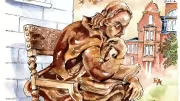
At least they got degrees. Shortly before the graduation of the class of 1823, 43 of 70 students were expelled, a punishment bestowed on a notoriously debaucherous group after the “Great Rebellion of 1823” (less famous, but perhaps more consequential, than the 1766 Butter Rebellion over bad food, shown above: the country’s first recorded student protest).
The “men” of 1823 entered Harvard at an average age of 16 and a half. For most of their first year, they pursued their studies peaceably. But when President John Kirkland, A.B. 1789, barred the class from celebrating the night before their first annual examination, the freshmen scoffed; they traveled 10 miles to the Neponset Hotel and bowled, sang, ate, drank, and played billiards until past four o’clock in the morning.
During the next few years, classmate Pickering Dodge chronicled “forbidden dinners, battles in commons, bonfires and explosions in the Yard, cannonballs dropped from upper windows, choruses of ‘scraping’ that drowned tutors’ voices in classroom and chapel, and plots that resulted in drenching their persons with buckets of ink-and-water,” wrote Samuel Eliot Morison, A.B. 1908, Ph.D. ’12, Litt.D. ’36, in Three Centuries of Harvard.
Meanwhile, a rivalry developed between the rebellious majority and a group of about 15 students they’d blacklisted as reputed informants. The animosity boiled over shortly before graduation when J.T. Woodbury, a member of the blacklist, reported classmate John P. Robinson to College authorities as the “principal promoter of division” within the class. Woodbury hoped doing so would make him more likely to be named Latin orator, an honor he believed would go to the more popular Robinson.
Robinson was initially punished lightly, but after Woodbury’s performance at “Exhibition Day” was met with uproar from a majority of the class, Robinson was expelled “for being the primary cause of the disturbances.” When Woodbury entered the College chapel after his rival’s suspension, a mob of angry students “thrust him headlong over the stairs.” After the expulsion of four students, a cohort met under the Rebellion Tree (see the second galley image)—a well-known site for plotting—and vowed not to return to order until the four students were reinstated and Woodbury sent home. They were then expelled themselves, raising the total to 43. Woodbury would become Latin orator.
Among those suspended was John Adams II (see the third gallery image), son of one president and grandson of another. A passionate letter from his father, John Quincy Adams, A.B. 1787, A.M. ’90, to his friend President Kirkland did little to inspire the College to reconsider. In the end, most of the expelled were granted degrees between 18 and 57 years later. Adams received one, too—posthumously.