MCMLVI masks. For their sixty-fifth reunion, whatever form it may take, members of the College class of 1956 conceived of a custom mask subtly emblazoned with a golden MCMLVI. Design and manufacturing were overseen by the inimitable Daniel J. McCarron, long-time University printer and self-described “senior design consultant” on any and all projects Crimson.
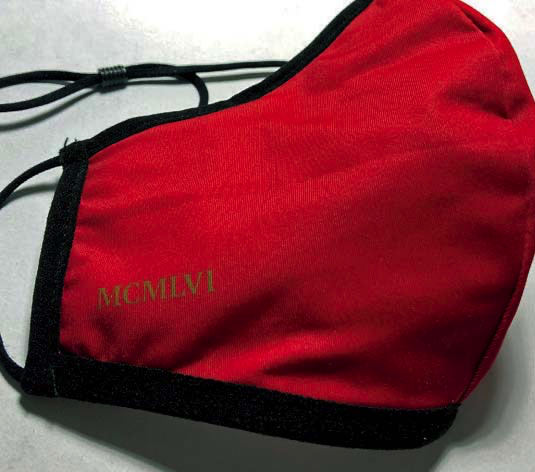
Photograph courtesy of Daniel J. McCarron
* * *
In due time. The Faculty of Arts and Sciences’ memorial minutes, recalling the lives and scholarship of late colleagues, are an art form—and, sometimes, a mystery. Consider the timing of the memorial for Gordon Randolph Willey, Bowditch professor of Central American and Mexican archaeology and ethnology emeritus, the towering figure in his field, who died April 28, 2002, but was not recognized until the faculty meeting of this past December 1. Whatever the reasons for the long interval, it feels somehow fitting because Willey’s research and person both seem bridges to a long-ago past.
“No one before or since has produced nearly as much published work on New World archaeology, let alone done so in North, Central, and South America,” the minute observed. “With energy, great drive, a formidable focus, and problem orientation, Willey published over a dozen exhaustive archaeological monographs; several dozen books on varied topics…; numerous edited volumes; and over 500 scholarly articles and book chapters” which in sum “push[ed] the field forward more than anyone else had up to that date.”
As for the innovator himself, he was decidedly an original: he loved, and crafted, limericks, and in retirement wrote archaeological mystery novels. The minute captured his presence in an exquisite miniature: “On a personal level, he transcended all of the wildly different social contexts that he experienced and relished over the course of his long, productive, and happy life, from Iowa everyman, to sunny California youth, to NCAA track star and budding archaeologist at Arizona, to archaeologist who survived the Florida swamps and Panama jungles, to dapper Harvard Professor and Tavern Club regular. With his impeccable taste—‘I love suits,’ he would occasionally allow—his gold pocket watch, his monocle, and his jaunty walk, he was as unique and wonderful as the institution he was so proud to serve.”
* * *
H.H.R. John Bassett ’60, Ds ’66, writes from Brookline, Massachusetts, about Henry Hobson Richardson, A.B. 1859, the leading nineteenth-century U.S. architect (Trinity Church, Harvard’s Sever and Austin Halls, a collaboration on the New York State Capitol, etc.). Much of his later work, including the Harvard commissions, was designed from his home and office in the residence at 25 Cottage Street, in Brookline (above), rented from his classmate and fellow Porcellian, Edward Hooper. Richardson’s friend and collaborator Fredrick Law Olmsted, A.M. 1864, LL.D. ’93, had a similar arrangement at his home and office, Fairsted, just down the street. Fairsted is now a National Historic Landmark museum operated by the National Park Service. Richardson’s house, in a National Register Historic District, has no further protection, and an application has been filed to demolish it (and adjacent homes) for redevelopment, subject only to Brookline’s current 18-month demolition delay (during which alternatives to razing the house can be sought).
Upon his premature death in 1886, Richardson left substantial debts; his widow stayed in the house at a nominal rent until Hooper arranged for her to acquire it in 1891. Following the 1998 death of his grandson, Henry Hobson Richardson II, the house was sold to two abutters in 2000.
There followed an intermittent 20-year preservation struggle, during which several offers to purchase and save the house foundered during difficult negotiations over a preservation easement, boundary lines, and other issues. In 2004 it was placed on Preservation Massachusetts’s “Most Endangered” list. Those interested in supporting preservation may comment to the Brookline Preservation Commission and Brookline Preservation Planner Tina McCarthy.