It is too soon to tell how COVID-19 will alter life and work within the University community over time. But it is a good bet that discovering how to foster engagement when academic interactions are remote has changed the ways teachers and students experience the classroom, even with in-person instruction restored. A task force convened by the vice provost for advances in learning has assessed what was discovered during remote and hybrid classes from March 2020 through the following academic year, and peered ahead. Its report on the future of teaching and learning at Harvard, published March 9, aims to prompt discussion about further applications—on campus, online, and worldwide.
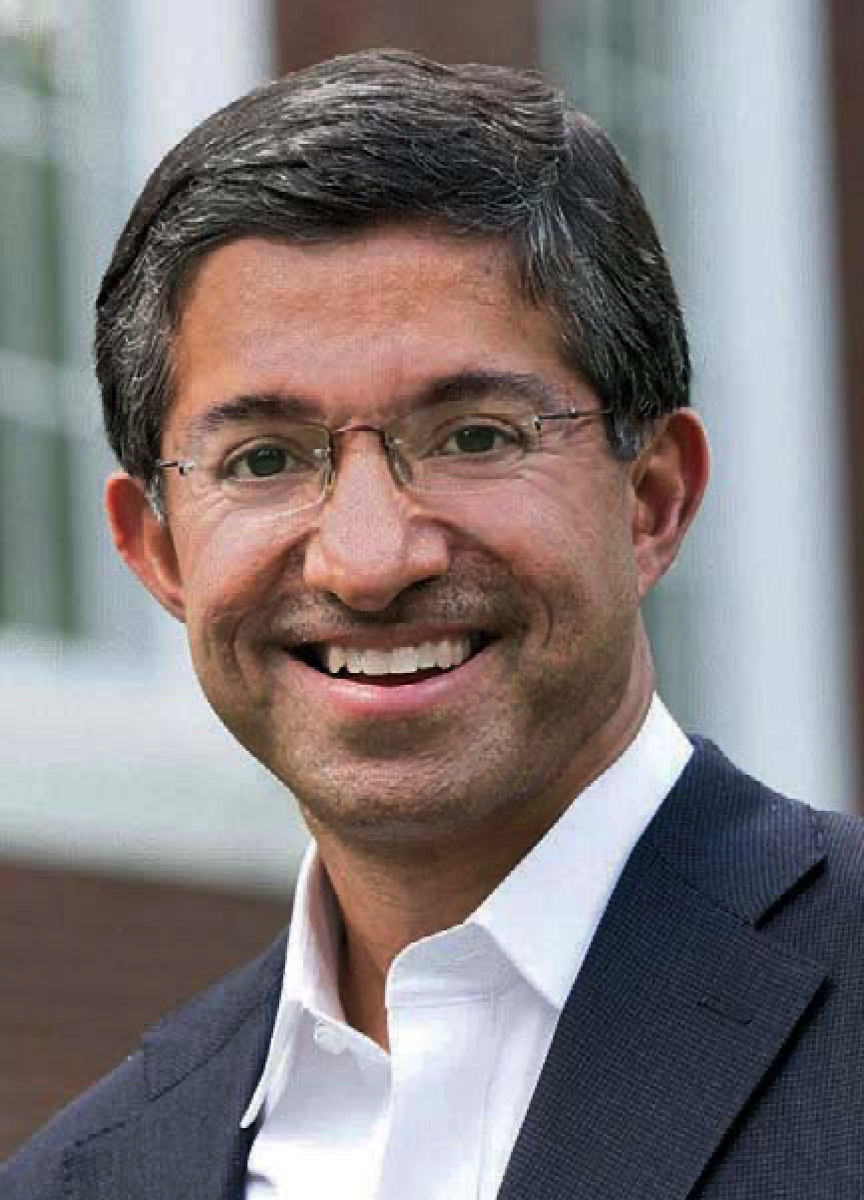
Bharat Anand
Photograph courtesy Harvard University
Vice provost Bharat Anand, the task-force chair, said that faculty members’ online and technologically enabled teaching extended back more than a decade to the Harvard-MIT edX venture. The first part of the report distills what was learned from that initial foray into translating full courses for free online distribution; subsequent, more focused efforts aimed at smaller learner cohorts and different phases of their education; and the Extension School’s extensive online operations.
Together, those efforts familiarized many faculty members with new ways of teaching, even before the pandemic forced all classes off campus. The more recent experiments brought forth important insights into using online tools to engage students, test their command of material frequently, enable them to learn from one another, and form their own learner communities (albeit online): a new form of the collaborative experiences that enrich residential, campus-based learning, for people who do not have the opportunity to access those options.
Reimagining the “classroom.” Anand emphasized that technology’s educational role is as “an enabler.” The part of the report on “blended learning” (in classrooms with online elements, and online with in-person elements), led by Harvard Graduate School of Education dean Bridget Terry Long, suggests just what might be enabled.
It had been generally known, from edX and other formats, that a full-length lecture, transmitted and disseminated to a screen (what Anand calls sending the class out like a PDF), results in passive experiences and diminishing student attention. As the report puts it, “Long lectures that were familiar in the residential classroom, or to which faculty and students had become accustomed, did not work well online.” What did work, on Zoom, was breaking courses into smaller chunks and exercises, and using the interactive and communication utilities online to make discussion and problem-solving the focus of class sessions. Overnight, large numbers of faculty members discovered the virtues of “flipping” their classes (with lectures taped for student viewing at any time, “asynchronously,” and active-learning-focused classes live, or “synchronous”). From the student perspective, Zoom instruction forced them really to engage.
De facto, active learning became widespread. Professors encouraged students to use the chat function to pose questions about material as it arose in a lecture or seminar discussion—with teaching assistants or fellow students posting answers in real time. Breakout sessions, organized in seconds, forced students to mingle with one another for fresh perspectives, rather than self-selecting the same cohort repeatedly. Students who preferred not to raise their hands were far more likely to engage using these tools. Faculty members and students collaborated on shared instruments like Google documents, enabling what Anand calls “simultaneous multi-person conversations.” He acknowledged teachers “don’t need technology” to effect such active engagement, but now they know how to use it when they want to—and how to incorporate outside experts from around the world into classrooms with a click of the keyboard, and to organize virtual office hours.
The result is the holy grail of online education —what the report calls “engagement at scale”: the promise of teaching vast student cohorts without sacrificing the elements of active, participatory learning. The inclusive effects are important and large. As Dean Long said separately, “One of the biggest takeaways for HGSE…was that there’s talent everywhere, and we actually have the tools—and the opportunity—to meet talented learners where they are and engage them in our programs.” Her school’s Ed.M. program, online for 2020-2021, “drew learners into our classrooms who might otherwise have never come to Harvard. We increased access for them, and they enriched our classroom conversations with new perspectives and experiences grounded in communities around the world.”
The task force report describes all these efforts as “reimagining the classroom,” incorporating “the best of online into residential settings and bringing a residential component to online programs. Blended experiences can offer new ways of teaching, learning, and meeting students where they are. At their fullest, they represent a fundamental shift in mindset beyond the binary alternatives of entirely in-person or entirely online offerings and learning experiences.”
Enriching content, expanding community. Anand, who has lots of experience from the Business School’s online program, is a champion of what the report calls “short-form digital content and learning experiences”; he led the task force’s work on these topics.
Compared to the traditional “unit of analysis for almost every Harvard residential degree program offering and online certificate offering,” the semester-long course, shorter instructional units present two opportunities, according to the report. Such “modular, impactful online learning experiences” can enrich residential, long-form (semester) classes and “meaningfully expand the impact of Harvard’s teaching beyond our physical campus.” (One beneficiary group might be alumni, who have strong interest in maintaining connections to faculty members and academic offerings.)
What the task force has in mind is a strategy for bringing uniformity to creating and distributing such chunks of learning, so they can be archived, searched, and plugged into classes or online courses as needed. Such short-form content might involve multiple media (texts, audio, video), forms (podcasts, for instance), and approaches (asynchronous/synchronous mixed classes, hybrid classes, online classes with occasional residential components), and so on. Pulling all this off, the report suggests, will require some centralized “curation” and partnerships for “marketing, distribution, and translation.”
The global footprint. Having mastered, or at least prototyped, such skills, how far might the University go in serving wider learner communities? Finley professor of engineering and applied sciences Michael D. Smith, dean of the Faculty of Arts and Sciences when edX was launched and now a task force member, said he was particularly interested in “the evolution from getting our educational materials available to a larger part of the world then, to really engaging” with such learners now. Within the task force, he was an evangelist for beginning a conversation about how the University can perceive itself participating, digitally, in a “world community.” The vision for Harvard Global Learning 2.0, as Smith outlined it—encompassing a meaningful percentage of the planet’s population—is among the longest-range of the report recommendations.
Next steps. Many significant issues arise from the task force’s overview. How willing is Harvard to confer degrees on non-resident learners? What is the definition of faculty members’ legitimate outside activities? Will Harvard offer its education (residential, hybrid, online-only) at different prices? How does the University define itself in the future, as a residential community in an online world, with faculty members finding a new balance between research and teaching? The report invites the entire community to take up those challenges, and makes clear that given the pandemic’s effects, instruction and Harvard’s understanding of what it does for whom and how, have changed. For a detailed account, see harvardmag.com/future-learning-22.