

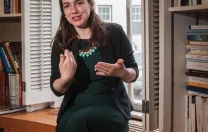
Kathryn davidson’s role in bringing an ASL class to Harvard, on one level, was incidental. The students calling for the class needed a faculty member’s signature, and an ASL researcher happened to arrive at the right moment. On another level, it mirrors the much more substantial relationship between the linguistic and deaf communities. Though it contributes to the debate over the language organ, Davidson’s work on deaf children is much more applied than most of her papers, which wade deep into theoretical semantics. She views applied research as part of “the social responsibility of running a lab that studies sign languages.” The study on children with cochlear implants became her most cited paper, because of its importance to studies of the deaf community. Linguists have been the first to discredit unsupported myths about language, like the notion that it’s harmful to raise children to be bilingual, or that sign languages were merely systems of gesture.
ASL “is one of the best cases of social justice in linguistics,” Davidson says. During the last half-century, linguists, led initially by the late William Stokoe, have documented the ability of sign languages to do all the things spoken languages can, but do them by using three-dimensional space instead of sound. Stokoe is widely credited with securing ASL’s status as a real language. During the same period, disability-rights activism produced the Rehabilitation Act of 1973, and later the Americans with Disabilities Act, the federal laws that gave people with disabilities rights to certain accommodations, like sign-language interpretation.
Psychology graduate student Annemarie Kocab, who is deaf, grew up going to a hearing school with a sign-language interpreter. (“I was what you would call ‘mainstreamed,’” she signs, as the interpreter by her side simultaneously translates her words.) Her hearing parents took the unusual step of learning ASL to communicate with her. Whatever progress has been made to advance the rights of deaf people, Kocab is bothered that many physicians remain at odds with the deaf community, and with linguistics research, in their view of language: “Many doctors advise parents to give their deaf children cochlear implants, and say, ‘You need to focus on spoken language only and don’t sign or use ASL,’” she says. “If the spoken language approach fails, well, then, they say, ‘Maybe you could try ASL.’ But we know that’s not how language works.” That may be changing, though: a widely cited 2015 paper in Pediatrics, titled “Should All Deaf Children Learn Sign Language?” advised, “The benefits of learning sign language clearly outweigh the risks.”


