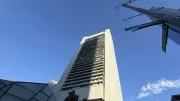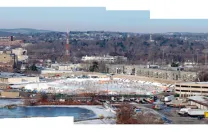
In January, the University placed a $480-million debt offering, in part to retire existing borrowings but also for $219 million of “project costs,” the majority associated with Harvard Law School’s Northwest Corner building (see “Legal Legroom,” January-February 2007, page 61, and “Sun, Wind, and Steel,” November-December 2009, page 16N). That 250,000-square-foot project was well begun before the financial crisis unfolded in 2008, and is being completed; occupancy is expected in the fall of 2011. Although it was anchored by two large gifts raised during that school’s recent capital campaign (of $25 million and a reported $30 million, respectively), the overall costs are estimated to be in the range of $220 million to $250 million, necessitating the financing. (The law school will likely have to begin servicing the debt and paying for operation and maintenance—multimillion-dollar new expenses—in fiscal year 2012.)
The other major campus construction—a complete renewal of the now-mothballed Fogg Art Museum, previously estimated to cost $350 million to $400 million—was authorized by the Corporation in December. Although that decision was not formally announced, exterior demolition began in late January. Thomas Lentz, Cabot director of the Harvard Art Museum, pronounced himself “pleased and relieved” that the work can proceed, given the cost of the “complex” overhaul and prevailing financial conditions.
The Renzo Piano-designed project, which will renovate the core building and its antiquated systems, will also yield additional gallery space and a new entrance along Prescott Street and art-study centers for faculty, student, and visitor use on the upper levels. Previously announced gifts from Emily Rauh Pulitzer, A.M. ’63, and David Rockefeller ’36, G ’37, LL.D. ’69, provided more than $70 million to advance the work. Other financing has not been reported, and fundraising continues. Lentz hopes that—following a planned 36 months of construction and up to a year to move the collections back to the reconstructed facility—the museum can reopen for the fall term in 2013.