Artist Matt Freedman’s “cancer treatment journal” about adenoid cystic carcinoma

Artist Matt Freedman ’78 confronts adenoid cystic carcinoma.

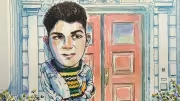
“This book,” writes Matt Freedman ’78, “reproduces a journal I kept in the fall of 2012 while I was undergoing care at Massachusetts General Hospital.” Friends gave Freedman, an artist and writer who lives in New York, a sketch book before he went to Boston, and “I decided I would gradually fill the thing up with whatever came into my head during the course of my treatment.” The result, hand-lettered and illustrated, is Relatively Indolent but Relentless (Seven Stories Press, $23.95), an unfiltered record as matter-of-fact as its subtitle, A Cancer Treatment Journal. The following is the first day’s entry, with some of the subsequent drawings.

Yesterday my colleagues and students gave me this sketch book to fill up over the next two months while I undergo radiation and chemotherapy. I’m going to get proton radiation to fight the tumor in my tongue. I will also get protons to fight the tumors in my lymph nodes in my neck. There will also be chemotherapy to sensitize the cancer cells. They hope they will get a “two-fer” out of the chemo and it will also attack the tumors in my lungs.

It’s October 3 and I’ve known for about two months that I have adenoid cystic carcinoma, a rare cancer that is “slow and indolent.” It moves slowly but is hard to stop.

No one knows how long the cancer has been in me. It could have been years. I’ve had a bad earache for years. For most of that time I thought it was caused by nighttime tooth grinding. I had mouth guards made that sort of worked, but not really, and not for long. And besides, the dog ate them every time it could.

I’m very sloppy and I let things go when I shouldn’t. Maybe that was the root of all the trouble.
You might also like

Radcliffe Institute Announces 2026-2027 Fellows

Scholars will tap Harvard’s intellectual resources during the coming academic year.

For This Poet, AI is a Writing Partner

Sasha Stiles trained a chatbot on her manuscripts. Now, her poems rewrite themselves.

How Stories Help Us Cope with Climate Change

The growing genre of climate fiction offers a way to process reality—and our anxieties.

Most popular

Telling Humanity’s Story through DNA

Geneticist David Reich rewrites the ancient human past.

Harvard Stem Cell Institute Names New Faculty Co-Director

Biology professor Lee Rubin is a leading expert on neurogenerative diseases.

Chinese Immigrants in Early America

Michael Luo ’98 on the first great wave of immigration—and of nativist anti-immigrant reaction

Explore More From Current Issue

A woman with long hair leans on a table, looking out a large window with rain-streaked glass.

A Harvard Economist Probes the Affordable Housing Crisis

From understanding gender pay gaps to the housing crisis, Rebecca Diamond’s research aims to improve lives.

Portrait of a man with white hair, wearing a black coat, arms crossed, thoughtful expression.

The Framer Who Refused to Sign the Constitution

Harvard’s Elbridge Gerry helped draft the U.S. Constitution, but worried it might create a new monarch.

White House and Harvard University buildings split diagonally with contrasting colors.

Harvard Weathers a Year of Turmoil

The federal government has launched unprecedented actions against the University. Here’s a guide.